Homes for sale in Paris
Île-de-France, France
About Paris
Real estate for sale in Paris, France: complete market analysis for international investors and buyers
Paris is, in terms of capitalization and prestige, one of the three or four most relevant residential real estate markets in the world, alongside London, New York, and Hong Kong. With approximately 2.1 million inhabitants within the city walls and 12.5 million in the metropolitan area, it is distributed across 20 arrondissements with very distinct characters — from the medieval fabric of the 1er and 4e (Marais) to the Haussmannian style of the 7e, 8e, and 16e, as well as the converted working-class neighborhoods of the 10e, 11e, 19e, and 20e.
For the international buyer — whether Portuguese, Brazilian, American, Middle Eastern, or Asian — Paris is a market dense with opportunities and pitfalls. Conventional gross yield is structurally low (3 to 3.5% in the mid-segment); asset value and long-term liquidity are the core attributes. It is worth analyzing in depth arrondissement by arrondissement, regulation by regulation, before committing capital.
What defines Paris as a market
Protected architectural heritage
Most of the built fabric of intra-muros Paris is Haussmannian (1853-1870, with expansions until 1914) — buildings made of Lutetian limestone, with six classic floors, balconies on the 2nd and 5th floors (étages nobles), a typical floor plan with an interior cour (courtyard), and chambre de bonne (maid's rooms) in the attics. This architectural uniformity is a structural factor: supply is geographically fixed and interior renovation is regulated by the Architectes des Bâtiments de France (ABF) and co-ownership (copropriété) regulations.
Twenty arrondissements, twenty markets
Paris is less a homogeneous city and more a collection of neighborhoods with their own dynamics:
- 1er arrondissement (Louvre, Tuileries, Châtelet) — tourist and heritage heart, historic buildings, limited and premium residential supply
- 2e (Bourse, Sentier) — central, former textile area, undergoing strong gentrification
- 3e (Marais Nord, République) — historic Marais, attracts families and creative professionals
- 4e (Marais Sud, Île Saint-Louis, Notre-Dame) — historic core, Île Saint-Louis is one of the most discreet and coveted addresses
- 5e (Quartier Latin, Sorbonne, Panthéon) — university-oriented, intellectual, central part of the Left Bank
- 6e (Saint-Germain-des-Prés, Odéon, Luxembourg) — perhaps the most coveted, with the Jardin du Luxembourg, bookstores, galleries, and iconic restaurants
- 7e (Invalides, Tour Eiffel, Champ-de-Mars) — diplomatic, formal, Eiffel Tower views sustain a material premium
- 8e (Champs-Élysées, Triangle d'Or, Madeleine, Monceau) — international luxury, corporate headquarters, hôtels particuliers
- 9e (Opéra, Pigalle, Nouvelle Athènes) — strongly appreciating, good for those wanting central location but at a lower price than the 6e/7e/8e
- 10e (Canal Saint-Martin, Gare du Nord, Gare de l'Est) — eclectic, with premium pockets (Canal) and functional zones
- 11e (Bastille, Oberkampf, Père Lachaise) — accelerated gentrification, intense nightlife
- 12e (Bercy, Nation, Daumesnil) — residential area appreciating, with Bois de Vincennes nearby
- 13e (Place d'Italie, Bibliothèque, Butte-aux-Cailles) — heterogeneous, with 1970s towers and premium pockets
- 14e (Montparnasse, Denfert, Plaisance) — solid residential, with an established family fabric
- 15e (Vaugirard, Convention, Beaugrenelle) — the most populous, residential, with good prices per sqm
- 16e (Trocadéro, Auteuil, Passy, Foch) — traditional bourgeois, with very premium sub-neighborhoods (Avenue Foch, Auteuil)
- 17e (Batignolles, Ternes, Monceau) — diverse, with Batignolles appreciating strongly and Plaine Monceau as traditional premium
- 18e (Montmartre, Goutte d'Or, Barbès) — Montmartre is premium and touristy; eastern parts are popular
- 19e (Buttes-Chaumont, La Villette) — appreciating, with Buttes-Chaumont as a family hub
- 20e (Père Lachaise, Belleville, Ménilmontant) — advanced gentrification, creative culture
Typologies and average prices in 2025-2026
Prices per square meter Loi Carrez (French legal measurement, excludes areas with ceiling heights below 1.80 m) vary significantly by arrondissement, floor, exposure, and property condition. Estimates for 2025-2026:
- 6e arrondissement: typically €14,000 to €22,000/m²; prime streets (rue Bonaparte, rue de Seine) can exceed this
- 7e arrondissement: €13,000 to €20,000/m²; a direct view of the Eiffel Tower adds 20-40%
- 8e arrondissement: €12,500 to €21,000/m²; Triangle d'Or (avenue Montaigne, rue Saint-Honoré) is the trophy segment
- 4e arrondissement (Marais, Île Saint-Louis): €13,000 to €19,000/m²; Île Saint-Louis is one of the most illiquid and coveted segments
- 1er and 2e: €12,000 to €17,000/m²
- 3e, 5e: €12,000 to €16,000/m²
- 9e, 16e (Passy, Auteuil): €10,000 to €15,000/m²
- 17e (Plaine Monceau, Batignolles): €10,000 to €14,500/m²
- 10e, 11e (Canal), 12e (Bercy): €9,000 to €12,500/m²
- 14e, 15e: €9,500 to €13,000/m²
- 18e (Montmartre): €10,000 to €14,000/m²
- 18e (Goutte d'Or), 19e, 20e: €7,500 to €11,000/m²
These prices fluctuate with macroeconomic cycles, ECB interest rates, and regulation. In 2023-2024, there was an average correction of 5-10% from the 2021-2022 peak, linked to higher rates. For 2026, the market shows signs of stabilization and a slight recovery.
Why consider Paris
Liquidity and market depth
Paris is one of the most liquid residential markets in the world. Average selling time in the mid-segment (€1-2 million): 60-120 days. In the high segment (€3-10M), 4-9 months. Demand is sustained by domestic, European, and international buyers (Americans, Brazilians, Middle Eastern, Asians).
Capital preservation
Over long horizons (10-20+ years), Parisian real estate has shown solid capital preservation in euros, with material accumulated appreciation across cycles. For wealth diversification in a strong currency and stable jurisdiction, it is a common alternative to London, Geneva, and New York.
Global position of Paris
A cultural, gastronomic, fashion, finance (La Défense), diplomacy, and art center. The 2024 Olympic Games brought infrastructure investment (Grand Paris Express — a massive metro extension until 2030+) and urban improvements that sustain long-term value.
Irreplaceable architectural heritage
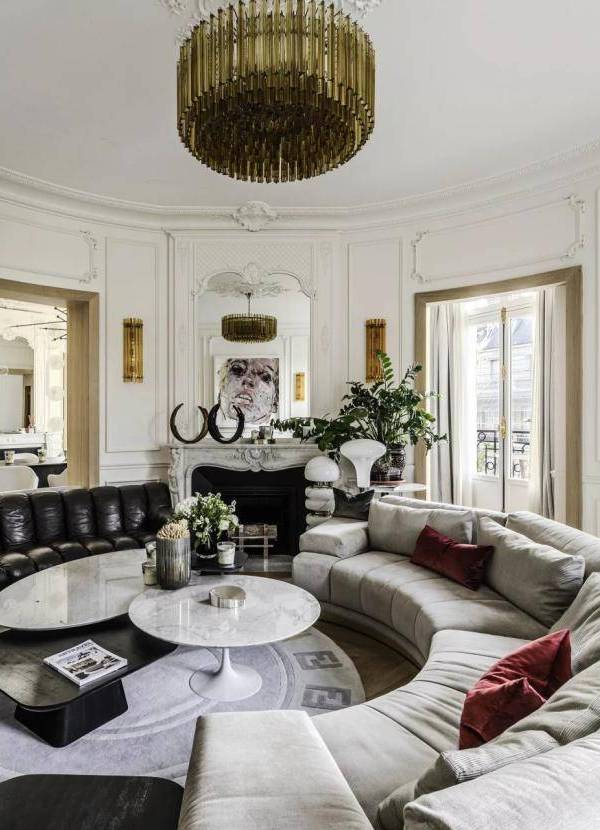
The Haussmannian fabric is fixed. No more is being built. An authentic late 19th-century apartment, with moldings, chevron parquet, marble fireplace, and a view of a tree-lined boulevard — it is a scarce asset by definition.
Points of attention
Structurally low conventional yield
Gross conventional rental yield in Paris is around 3 to 3.5% in the mid-segment; 2 to 2.8% in the premium segment. Net of expenses (taxe foncière, charges de copropriété, management, vacancy, taxes), the cash return is often less than 1.5-2% per year. Paris is not an aggressive yield market — it is a market for capital preservation and long-term appreciation.
Severe restrictions on tourist rentals
Short-term rentals (like Airbnb) are heavily regulated in Paris:
- Primary residences can be rented for short periods up to 120 days per calendar year (limit to be reduced to 90 days by new legislation)
- Secondary residences rented for short periods require compensation (converting commercial property into residential equivalent) — a complex and expensive system
- Mandatory registration with a declaration number from the municipality
- Active enforcement by the Mairie de Paris and civil courts; significant fines for violations
- Investment thesis via intensive Airbnb is not viable in most configurations
Loi Climat — energy renovation obligation
Buildings with a DPE (Diagnostic de Performance Énergétique) rating of F or G face increasing restrictions:
- Rental of class G properties prohibited since 2025; class F from 2028; class E from 2034
- Apartments with poor ratings are discount material in the market (15-30% below class C or D equivalents)
- Energy renovation in an old Haussmannian building is complex — windows in co-ownership, insulation limited by architectural regulations, material costs (€500-1,500+/m²)
- Checking the DPE before purchase is an essential step
Frais de notaire and transaction costs
Buying in France involves high costs:
- Frais de notaire for ancien (resale): ~7-8% of the price (includes departmental taxes ~5.8%, municipal tax 1.2%, notary fees ~1%, administrative costs)
- Frais de notaire for neuf (first sale, new): ~2-3%
- Agency fees: typically 4-6% of the price, paid by the buyer or seller according to the contract
- Total acquisition costs for ancien: easily an additional 10-13% on top of the price
Charges de copropriété
Monthly co-ownership costs (building maintenance, concierge/gardien, cleaning, central heating, elevator, reserve fund) can be material — €30 to €100/m²/year in average buildings; €80 to €250+/m²/year in premium buildings with services (Avenue Foch, Île Saint-Louis). For a 120 m² apartment in a premium building: €1,500 to €2,500+/month.
Travaux exceptionnels and fonds de travaux
Haussmannian buildings have major work cycles: facade renovation (mandatory every 10 years in several districts), roof, staircase, elevator. The Assemblée Générale approves budgets; each owner's share can be tens of thousands of euros for large works. Check the history and upcoming works before buying.
Rising Taxe foncière
Annual tax on the owner, calculated based on the cadastral value. In Paris, the tax rose materially in 2023 (~50% increase) and continued to rise in 2024-2025. For a 120 m² apartment in a central arrondissement: typically €1,500 to €4,500/year.
IFI — Impôt sur la Fortune Immobilière
Annual tax on real estate wealth above €1.3 million (net value of mortgage debt). Progressive rates from 0.5% to 1.5%. Applies to French residents on worldwide assets and to non-residents on assets in France. Careful structuring (SCI, démembrement, financing) can reduce the taxable base — tax advice is essential.
Real estate Plus-value
Capital gains on a future sale are taxed:
- For residents: primary residence exempt; other properties taxed at 19% + 17.2% social contributions = 36.2%, with progressive abattements (allowances) based on duration of ownership (total exemption after 30 years for social contributions; 22 years for income tax)
- For non-residents: similar regime but with particularities; depends on the applicable double taxation treaty (Brazil-France, Portugal-France, etc.)
Co-ownership restrictions
Co-ownership regulations can restrict use (Airbnb, office, commerce), pets, works, and exterior changes. Some co-ownerships are "strictly for residential use". Read the full regulations before purchasing.
Protests and urban mobility
Paris has an active protest culture — strikes, protests (gilets jaunes, pensions, etc.) occasionally affect access. Urban mobility is intensely managed, with increasing restrictions on vehicles (ZFE zones, reduction of lanes on boulevards). For residents with a car, this is a factor to consider.
Noise and nuisances in central areas
Central arrondissements with intense nightlife (Marais, Bastille, Pigalle, Canal Saint-Martin) have material noise on weekends. Apartments sur cour (facing the inner courtyard) are generally preferable in noisy areas, even with a lesser view.
Restricted liquidity in the very high segment
The market in the segment up to €5-7 million has solid liquidity. Above €10 million, the buyer pool reduces to a few dozen domestic and international buyers per year. Hôtels particuliers or apartments on prime streets can take 12-36+ months to sell.
Investment analysis
Historical appreciation
Over a 20-year horizon (2005-2025), prices per m² in intra-muros Paris approximately doubled nominally in the mid-segment (adjusting for inflation, real appreciation was more modest). There were clear cycles: strong rise 2005-2011, stabilization 2011-2015, new upward cycle 2015-2021, correction 2022-2024. For 2026, the expectation is for a moderate recovery as ECB rates stabilize.
Conventional rental
Gross yield 3 to 3.5%. Net after expenses and taxes: typically 1.5 to 2% for French residents; may be lower for non-residents depending on the structure. Encadrement des loyers (rent control) has been in effect in Paris since 2019 — it defines a rent ceiling by zone and typology. Property above the ceiling requires documented justification.
Location meublée (LMNP)
Long-term furnished rental has an advantageous tax regime (BIC regime, accounting depreciation, possibility of micro-BIC or réel regime). For a sophisticated investor in a furnished apartment, the tax return after deductions can be higher than conventional rental.
Bail mobilité and student housing
Short-to-medium term rental for professionals on assignment or students (1-10 months) is regulated and has grown post-2020. It can offer higher yields than conventional rental but with more management.
SCPI and SCI
For an investor without a specific thesis for owning property in Paris, SCPI (Société Civile de Placement Immobilier) offers diversified exposure to French real estate with professional management — typical 4-5.5% yield but with heavy taxation. SCI (Société Civile Immobilière) is the standard structure for holding one's own property with inheritance benefits.
For international buyers — specificities
Brazilians
- Brazil-France Treaty avoids double taxation on real estate income; obligation to declare in both countries
- Possibility of financing via French banks (BNP, Société Générale, Crédit Agricole) with a 30-50% down payment, competitive rates in euros
- Plus-value on future sale taxed in France; also declared in Brazil with a tax credit
- For non-tax residents in Brazil (routine in BR/FR transfers), tax rules change materially
- Banks with Private Banking serving Brazilians in Paris: BTG Pactual Europe (Luxembourg), Itaú Europe, Banco do Brasil Paris
Portuguese
- Portugal-France Treaty applicable; declaration in both
- Established Portuguese community in Paris and the outskirts (Champigny, Sarcelles, La Courneuve), with premium pockets in central arrondissements
- Portuguese banking in Paris (Caixa Geral, Millennium BCP, BPI) facilitates management
- For residents in Portugal with the NHR regime post-2024 reform, joint Portugal-France planning is essential
Americans
- Obligation to report FBAR and FATCA for French properties and accounts
- USA-France Treaty applicable
- French estate tax applies to non-residents on real estate in France; US federal estate tax may also apply — planning via SCI or holding company is common
Other internationals
- Buyers from the Middle East, Russia (with applicable sanctions), China — check current restrictions on cross-border flows and compliance (rigorous KYC/AML in France)
- Notary requests proof of origin of funds; international transfers subject to bank scrutiny
For whom this market makes sense
- International family with a long horizon looking for capital preservation in a strong currency and stable jurisdiction
- Buyer with children in European education (Sciences Po, HEC, INSEAD, École Polytechnique) combining a family apartment with an educational base
- Senior professional in finance, diplomacy, tech (La Défense, Station F, Saclay) based in Paris
- International buyer with a family or business nexus in Paris
- Capital preservation investor who accepts low yield in exchange for asset quality and liquidity
- Cultural pied-à-terre buyer for periodic use (a few weeks a year) as a complement to a primary residence in another jurisdiction
- Intergenerational wealth succession — Paris works as a long-term capsule via SCI, property démembrement, and family succession planning
- Family office diversifying global real estate exposure
For whom it does NOT make sense
- Those seeking aggressive rental yield — Paris is structurally low
- Those wanting tourist rental via intensive Airbnb — substantially closed by regulation
- Those needing quick liquidity in the very high segment
- Those who do not tolerate complex taxation (IFI, plus-value, taxe foncière, copropriété, inheritance)
- Those unable to absorb charges de copropriété and travaux exceptionnels in old buildings
- Those looking for a single-family home with a garden — intra-muros Paris does not offer this; alternatives in the petite couronne (Neuilly, Boulogne, Saint-Cloud, Vincennes)
- Those preferring lighter taxation — Monaco, Switzerland, Portugal NHR, Italy's flat tax regime, Dubai are alternatives with different profiles
- Those expecting explosive appreciation — Paris appreciates moderately over long cycles, it does not skyrocket
Comparison with global reference markets
- vs. London (Mayfair, Belgravia, Kensington) — London has a deeper trophy segment and post-Brexit taxation in flux (abolition of the non-dom regime). Paris is more fiscally predictable but with IFI
- vs. New York (Upper East Side, Tribeca, West Village) — NYC has comparable prices per sqft in the high segment, with the complexity of coop vs. condo and heavy NY/federal taxation. Paris is more formalized
- vs. Lisbon (Príncipe Real, Chiado, Lapa) — Lisbon is one of the hottest markets in Europe post-Golden Visa (which is undergoing regulatory change). Prices per m² are much lower than in Paris, but market depth and prestige are lower
- vs. Madrid (Salamanca, Recoletos, Chamartín) — Madrid is appreciating rapidly with relatively light Spanish taxation in some areas. Increasing liquidity
- vs. Milan (Quadrilatero, Brera, Porta Nuova) — Milan has a favorable tax regime for new residents (flat tax, substitute tax regime); market on the rise
- vs. Geneva / Zurich — Switzerland has a structural premium and negotiable taxation, but limited supply and restrictive regulation on non-residents (Lex Koller)
- vs. Monaco — Monaco has very favorable taxation but prices per m² are 2-4x higher than in central Paris
Hôtels particuliers and trophy segment
Paris has a limited but deep supply of hôtels particuliers — private urban palaces with gardens, frequently in the 7e, 8e, 16e (Foch, Auteuil), 6e, and 4e (Marais). Price range €15 to €100+ million. Very illiquid market (few transactions per year), discreet, frequently off-market. For the ultra-premium international buyer, it is an alternative to Holland Park (London), Carnegie Hill (NYC), Cap Ferrat, or Megève (in another profile).
Trends for 2026 and coming years
Paris enters 2026 in a phase of stabilization and selective recovery. Positive factors:
- Grand Paris Express — massive metro extension (lines 14, 15, 16, 17, 18) reorganizes regional geography; positive impact on served areas and the petite couronne
- Gradual stabilization of ECB rates sustains demand
- Persistent international demand (Americans, Brazilians, Gulf states)
- Post-Olympic infrastructure investments
Pressure factors:
- Mandatory energy renovation will strongly discriminate against poorly rated buildings
- IFI and heavy taxation may shift capital to lighter jurisdictions
- Encadrement des loyers limits yields
- Regulation against Airbnb continues to tighten
- Geopolitical tensions and treaty revisions may affect international flows
What to evaluate before buying in Paris
- Complete Diagnostic Technique: DPE (energy), asbestos, lead, electrical, gas, ESRIS (risks)
- Building Carnet d'entretien and the last three PV (minutes) of the assemblée générale
- Travaux votés et travaux à venir — check for decided but unexecuted works and predictable travaux exceptionnels
- Charges de copropriété — 3-year history
- Règlement de copropriété — restrictions on use, pets, Airbnb, alterations
- Surface Loi Carrez — verify certified measurement
- Property condition — request an independent technical inspection, especially in pre-1948 buildings (lead, asbestos possible)
- View, exposure, floor — étages nobles (2-3-4) add material value; orientation (south-west preferred) likewise
- Cour vs. rue — an apartment sur cour for noisy streets is often the better choice
- Architectural status — check if the building is classé or inscrit (Monuments Historiques); restrictions on alterations
- Estimated Frais de notaire — request a detailed simulation
- Legal structure: individual vs. SCI vs. holding company (for internationals)
- Succession planning — French inheritance law is specific (forced heirship for children); planning via SCI, démembrement, donation-partage
- Tax planning in conjunction with the country of tax residence
Petite couronne — an often forgotten alternative
For a buyer who values quality of life with more space and a garden, but a real connection to Paris, it is worth considering:
- Neuilly-sur-Seine — traditional bourgeois, international schools, high prices
- Boulogne-Billancourt — modernized, with the adjacent Bois de Boulogne
- Saint-Cloud, Garches, Marnes-la-Coquette — premium residential to the west
- Vincennes — traditional town to the east, with the Bois de Vincennes and direct RER A to Paris
- Levallois-Perret, Issy-les-Moulineaux — modern, with recent towers
- Le Vésinet, Saint-Germain-en-Laye, Versailles — in the grande couronne, with historic houses and gardens
For those looking for houses and apartments for sale in Paris, France, the takeaway is clear: one of the most solid real estate markets in the world, with depth, liquidity (in the mid-segment), and irreplaceable architectural heritage. Conventional yield is low; value lies in capital preservation, asset quality, and prestige. It has material fiscal and regulatory complexity (IFI, plus-value, encadrement, DPE, copropriété) that requires specialized advice. It is a solid choice for specific profiles with a long horizon and a well-thought-out wealth structure.
Consult our updated selection of properties in Paris and Île-de-France.