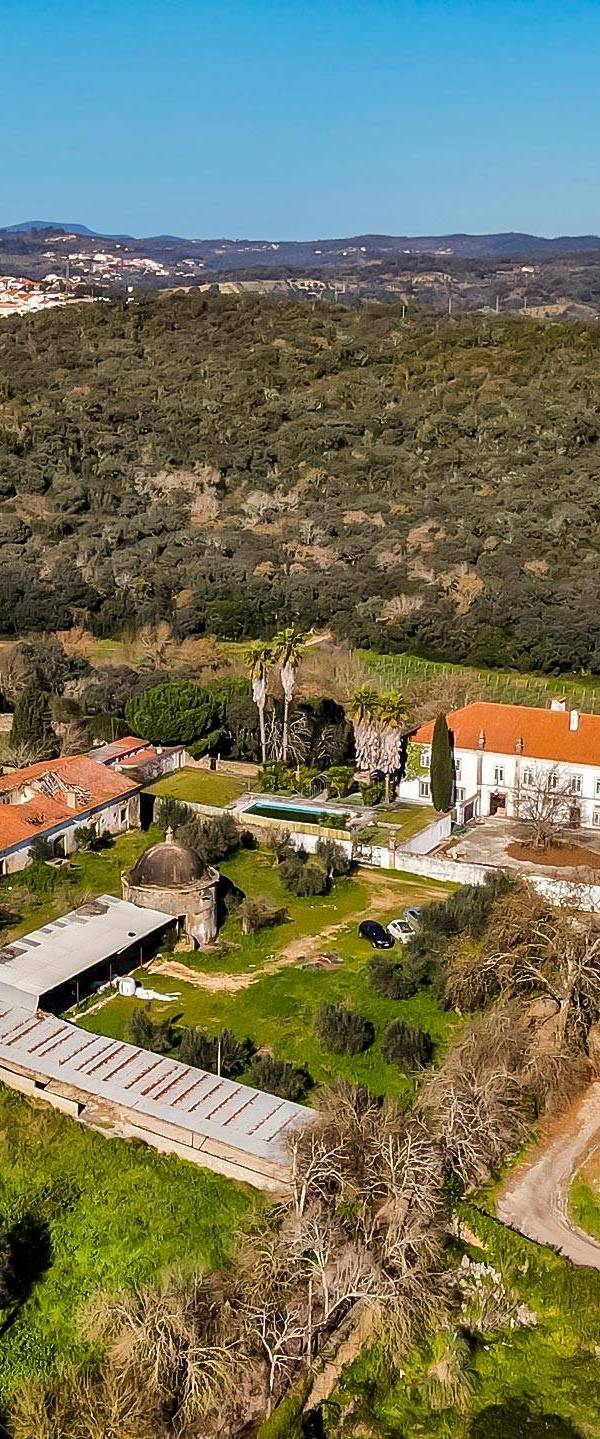
Homes for sale in Tomar
Santarém, Portugal
About Tomar
Properties for sale in Tomar, Portugal
Tomar is a municipality in the Santarém district, in central Portugal, with about 40,000 inhabitants. It is located approximately 130 km northeast of Lisbon — 1h15 to 1h45 by car via the A23/A1, or about 2 hours by the CP train line. It is historically known for the Convento de Cristo, classified by UNESCO as a World Heritage Site in 1983, the former headquarters of the Order of the Knights Templar in Portugal and, later, the Order of Christ. The municipality blends a dense historic core, the Nabão riverside area, and rural territory spread around it.
The real estate market in Tomar operates in a distinct segment from the Portuguese coast. There is no consolidated international community on the same scale as the Algarve, Lisbon, or Cascais — which is reflected in significantly lower prices and a slower market pace. T2-T3 apartments in the urban area typically range between 90 and 250 thousand euros. Traditional houses and villas in the historic center, depending on condition and size, range between 150 and 500 thousand euros. "Quintas" (country estates) with agricultural land, depending on area and infrastructure, can vary between 200 thousand and over 1 million euros.
The character of the region
Dense historical heritage
The Convento de Cristo, built in the 12th century and expanded over four centuries, is the city's central monument. The Templar Charola (rotunda), the cloister of King John III, and the Manueline Window (one of the iconic pieces of Portuguese Manueline style) are references of art and architecture. The Castle of Tomar surrounds the convent. The city's historic core has narrow streets, churches (Santa Maria do Olival, São João Batista), the Synagogue (one of the few surviving medieval ones in Portugal), and civil buildings from the 15th-18th centuries.
Festa dos Tabuleiros (Festival of the Trays)
A quadrennial tradition classified by UNESCO as intangible cultural heritage. Women of the city carry trays decorated with bread, flowers, and ribbons in a procession through the streets. The festival attracts national and international visitors during the days it occurs, but it is a periodic event — it does not drive tourism continuously as happens in the Algarve.
Inland location
Tomar is geographically inland — it has no coast, and the nearest airport is Lisbon (about 1h30 to 2h depending on traffic). For those seeking direct proximity to the sea, it is not an appropriate destination. For those seeking a traditional Portuguese environment, the green landscape of the center of the country, and dense historical heritage, it makes sense.
Mata Nacional dos Sete Montes
A forest park next to the convent, with 39 hectares, gardens, lakes, and fauna. It is the city's central green space and a factor in the daily quality of life for residents.
Sub-zones of the municipality
Historic Center
Around Praça da República, with the Church of São João Batista and the Town Hall. Traditional Portuguese houses, some old manor houses, and historic civil buildings. Many properties require significant rehabilitation. Range 120 to 400 thousand euros for houses; some historic small palaces can exceed 600 thousand.
Nabão Bank and Riverside Area
Next to the Nabão River, with the historic Levada de Tomar and old mills. Houses with river views are a sought-after product. 200 to 500 thousand.
São João Baptista and Santa Maria dos Olivais
Urban parishes with a mix of new apartments, family houses from the 1960s-2000s, and some areas undergoing revitalization. T2-T3 apartments 90 to 200 thousand; villas 200 to 450 thousand.
Asseiceira, Beselga, Madalena, Sabacheira
Rural parishes of the municipality, with traditional villages, houses on rustic land, and estates with olive and fruit orchards. Properties in old clusters can cost from 50 thousand euros (needing total rehabilitation) up to 400 thousand for estates in good condition. Larger estates with agricultural land can exceed 1 million.
Carregueiros and surroundings
Residential areas further from the center, family houses on large plots. 150 to 350 thousand.
Property Typologies
- Traditional houses in the historic center — 120 to 400 thousand (many to rehabilitate)
- Urban apartments T2-T3 — 90 to 250 thousand
- Family villas in urban areas — 200 to 450 thousand
- Rural estates (quintas) with agricultural land — 200 thousand to 1 million+
- Houses in rural villages (many to rehabilitate) — 50 to 300 thousand
- Houses with views of the Nabão River — 250 to 600 thousand
- Building plots — variable according to location
- Historic palaces (rare) — unique product, without fixed comparables
Market Analysis
Appreciation
Tomar has appreciated much more modestly than Portuguese coastal areas. While Lisbon, Cascais, Algarve, Porto, and Comporta experienced average increases of 8-15% per year in various periods of the last decade, Tomar remained at a pace of 3-5% per year on a long-term average, with some periods of stagnation. For 2026, the expectation is for moderate growth (2-5%), with differences between urban and rural products.
Liquidity
The market is less liquid than the coast. T2-T3 urban apartments in good condition can sell in 3-9 months. Historic houses for rehabilitation can take 12-24 months or more, depending on the asking price and condition. Rural estates with specific characteristics (extensive land, buildings to rehabilitate) can stay on the market for 1-3 years.
Tourist Rental
Tomar has some Local Accommodation (AL) activity around the Convento de Cristo, but the tourist flow is significantly lower than in coastal areas. Gross yields from AL are modest (3-5% per year on average), with marked seasonality (Summer + festivities). For investors focused on AL, coastal alternatives generate more consistent returns.
Conventional Rental
Small but stable market. Local demand from young families, teachers, professionals linked to the Polytechnic Institute of Tomar, and public administration. Annual gross yields between 4-6%, depending on the product.
Points of Attention
Small market and limited supply of specialized professionals
The real estate market in Tomar is small in volume. There are fewer real estate agents, specialized lawyers, architects with experience in heritage rehabilitation, and qualified contractors compared to Lisbon or the Algarve. For complex rehabilitation projects, it is often necessary to bring in professionals from Lisbon or Coimbra — with corresponding costs.
Historic houses often need significant rehabilitation
Many properties in the historic center are 100-300 years old. Structure, roof, electrical installations, and plumbing often need total intervention. In protected zones (convent perimeter), there are heritage restrictions on what can be altered. Budget 800 to 1,500 euros per m² for complete rehabilitation, with timelines that can exceed 18 months including municipal licensing.
Distance from the sea and international airports
Lisbon's Humberto Delgado Airport is 1h30-2h away. The nearest beach (S. Pedro de Moel, Nazaré) is about 1h-1h15 away. For buyers accustomed to direct access to the sea or frequent flights, this distance is a real factor.
Climate — hot summers, cold winters
Tomar has an inland climate. Dry summers with regular temperatures above 30°C between June and September, with peaks above 38-40°C during heatwaves. Winters can have frosts, with temperatures close to 0°C on the coldest nights. Historic houses are often challenging to heat and cool efficiently.
Local economy in transition
Tomar was historically an industrial city (paper, textiles), with a decline in traditional industries in recent decades. The current economy has a significant component of public administration, local commerce, and the Polytechnic Institute, with growing tourism but still far from the economic weight it has on the coast. For those looking for a local job market in specific sectors, opportunities are limited.
Demographic challenges
Like many cities in the Portuguese interior, Tomar has lost population over the last decades and has a high average age. This dynamic affects real estate market dynamism, service offerings, and local investment. There is a recent counterpoint with the arrival of remote workers and digital nomads, but still on a modest scale.
Risk of forest fires
The rural territory of Tomar has Atlantic forest and pine forest. Dry summers and heatwaves have the potential for significant forest fires, as has occurred in several summers in recent decades in various areas of the Portuguese interior. Properties in forest zones should check the municipal fire management plan and mandatory protection strips (10-50 meters depending on regulations).
Lack of a consolidated international community
Compared to Cascais, Algarve, Comporta, or Ericeira, Tomar does not have an established international community of critical size. For expats who value regular interaction in English, international schools, international commerce, or a cosmopolitan environment, this is a relevant factor. The supply of private international schools in the region is limited — the nearest are in Carcavelos/Cascais or Lisbon.
Bureaucracy in heritage zones
Properties within the protection perimeter of the Convento de Cristo (UNESCO) and the classified historic center have additional licensing regulations by entities such as the Directorate-General for Cultural Heritage (DGPC). Renovations, expansions, and exterior changes often require complex approvals that can take months or years.
Internet and digital infrastructure
In urban areas, fiber optics are available on most streets. In rural villages, infrastructure may be inferior — check before buying with the intention of permanent remote work.
Taxation and Ongoing Costs
- IMT (Municipal Property Transfer Tax) — progressive according to value and use. For primary residences below 100 thousand euros, often exempt or with a reduced rate; intermediate values between 1% and 6%
- Stamp Duty: 0.8% on the deed value
- Annual IMI: 0.3-0.45% of the Tax Asset Value, according to municipal regulations
- Notary and registration fees: typically 800 to 2,500 euros
- Lawyer: 1.5 to 4 thousand euros recommended for foreigners and historic properties
- Total transaction costs: typically 5-8% of the purchase price
- Maintenance in historic houses: 1-2% of the value per year in fair condition; more for large properties or those in poor condition
- Home insurance: variable; higher in forest zones
For International Buyers
- Foreigners can buy without restrictions
- NIF (Tax ID) mandatory — request online or via a tax representative
- Non-Habitual Resident (NHR) regime was substantially changed in 2024 — it does not accept new beneficiaries under the previous terms; consult current regulations
- Golden Visa since October 2023 does not include direct investment in residential real estate; alternatives in qualified funds remain
- D7 Visa: relevant for retirees and passive income
- Mortgage in Portugal: available for foreigners at various banks (BCP, Santander, CGD, BPI, Novo Banco), typically 60-70% LTV
- For European investors resident in EU countries: tax regulations for assets outside the country of origin may apply
Who this market makes sense for
- European retiree looking for inland Portugal, a cost of living significantly lower than the coast, a traditional environment, and historical heritage
- Digital nomad or remote worker who prioritizes affordable prices, a house with historical character, and does not need daily proximity to the sea
- Heritage rehabilitation investor with patience for 12-24 month projects and a taste for historical heritage
- Portuguese family looking for an inland city with schools, services, and controlled cost of living
- Rural estate buyer with a project for rural tourism, organic farming, or a retreat
- Buyer passionate about Templar and medieval architecture — Tomar is a rare global destination for this interest
Who it does NOT make sense for
- Those seeking direct proximity to the sea — Algarve, Cascais, Ericeira, Comporta make more sense
- Those needing a nearby international airport — Lisbon is 1h30-2h away
- Those needing an established international community and international schools — limited in Tomar
- High-volume tourist rental investor — tourist flow is moderate and seasonal
- Those seeking a mild climate year-round — Tomar has hot summers and cold winters
- Those underestimating heritage rehabilitation costs — budgets usually exceed forecasts
- Those expecting rapid appreciation — the market is slower than coastal areas
Comparable Alternatives
- Óbidos: emblematic medieval village, closer to the coast, small market
- Évora: inland city with a historic Cathedral and Roman heritage, Alentejo
- Coimbra: larger university city, with more infrastructure and a dynamic market
- Castelo de Vide or Marvão: small-scale Alentejo alternatives
- Sintra: historic but close to Lisbon, with a significantly more expensive market
- Inland Algarve (São Brás, inland Tavira): combination of a traditional market with proximity to the sea
Trends 2026 and Coming Years
Tomar enters 2026 in a stable and moderate market. Investment in rehabilitation in the historic center continues, driven by tax incentives (Urban Rehabilitation regime, IFRRU) and the gradual arrival of foreign buyers discovering the Portuguese interior as an alternative to the coast. Demand for rural houses grows with the remote work trend. Main risk: weak local economy and demographic challenges limit dynamism. Opportunity: for buyers with patience and rehabilitation capital, there is real value in products in the historic center or rural estates.
For those looking for houses and properties for sale in Tomar, Portugal, the region offers a distinct product: UNESCO Templar heritage, a traditional Portuguese environment, prices significantly below the coast, and a market in a phase of gradual discovery by foreign buyers. For a specific profile — European retiree, remote worker, rehabilitation investor, family with a taste for the Portuguese interior — it can be a solid choice. For coastal, international, or high tourist yield profiles, other Portuguese alternatives exist.
Consult our updated selection of properties in Tomar center, rural areas of the municipality, and throughout the Santarém district.
When you contact us through a property page, we forward your enquiry to our partner broker, who holds the full information on that specific property — the Alojamento Local short-term rental licence where one exists, condominium charges, registry status and negotiation terms.