Homes for Sale in Praia do Diogo – BA, Brazil
Bahia, Brazil
About Praia do Diogo
Praia do Diogo — or Santo Antônio do Diogo, as it appears on maps and in the mouths of the people who live there — is a hamlet in Mata de São João, on the northern coast of Bahia, about 73 km from Salvador. It sits on the same stretch of coast as Praia do Forte and Imbassaí and belongs to the same municipality, but anyone who arrives understands within five minutes that it is a different thing altogether. Praia do Forte has a pedestrian avenue, established hotels and activity almost all year round. Diogo has a dirt road, a handful of houses, two or three good restaurants and a silence that is, for a certain kind of buyer, precisely the product.
That difference is not a brochure detail. It sets the price, it decides who buys, it decides how long a property takes to resell, and it decides what can and cannot be built. It is worth understanding before looking at any listing.
Where it is and how you get there
Access is via the BA-099, the highway known as the Linha Verde, which leaves Salvador and follows the coast northwards. From Salvador it is roughly 73 km and around an hour and a half by car, depending on traffic leaving the city. Salvador's international airport lies on the way, which shortens the journey considerably for anyone arriving by air.
The part that matters is the end of the route. The village is not on the edge of the highway: you leave the asphalt and drive about three kilometres of dirt road to reach the hamlet. In dry weather it is an easy road that any car can handle. In the rainy season it is a different conversation, and there are stretches that call for a higher vehicle. Anyone planning to live there year round, to rent by the season or to receive guests needs to treat that as part of the property, not as a footnote about the journey.
A trail leaves the village and cuts through the dunes to the beach, and along the way there is a wooden bridge over the Imbassaí River. It is one of the most beautiful walks on the northern coast and it is, at the same time, the exact measure of the scale of the place: you reach the beach on foot, through the dunes, not by driving onto the sand.
The character of the village
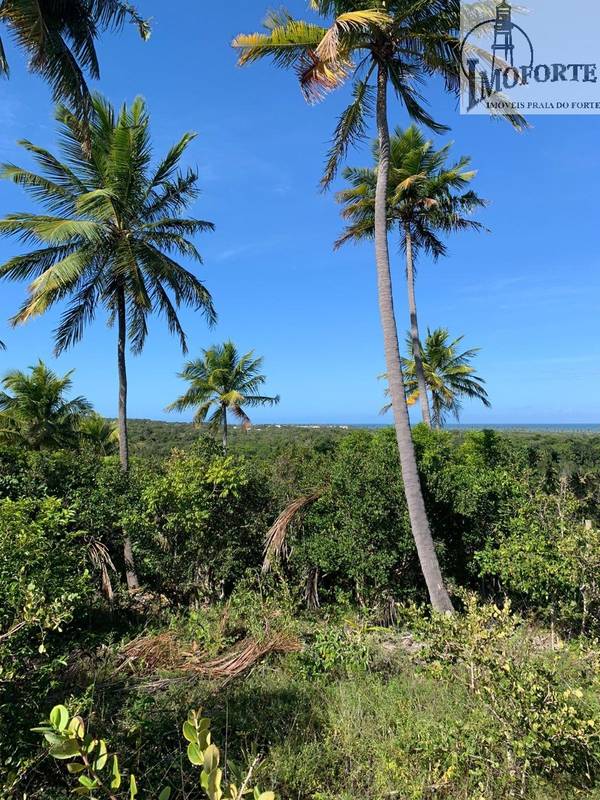
Diogo is rustic by design and by circumstance. There are no high-rises, there are no resorts inside the hamlet, and there is none of the commercial fabric that Praia do Forte developed. What exists is a small village of low houses and coconut palms, with a life that turns around the beach, the river and a small number of establishments.
Food is, curiously, one of its strengths. Places such as Sombra da Mangueira and Domingos do Diogo have built a reputation beyond the hamlet, and part of the weekend traffic comes from people driving down from Praia do Forte or Salvador simply to have lunch. That is a relevant signal: it shows the place draws visitors, even without the infrastructure of an established destination.
The neighbouring beach, Santo Antônio, is half deserted, isolated by dunes and coconut groves, with natural pools at low tide. It is beautiful and it is lightly visited. What people buy here is, above all, that.
What is on the market in Diogo
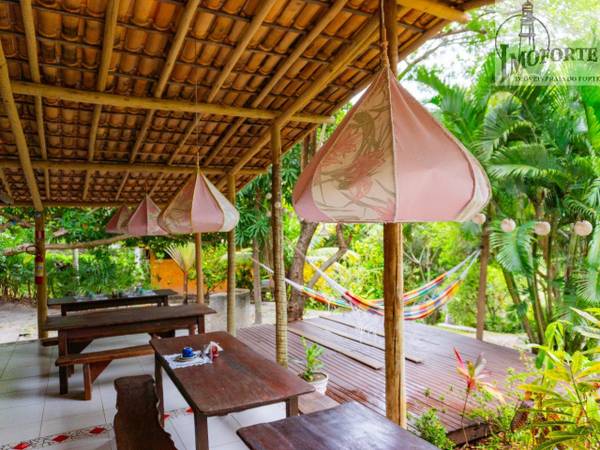
Inventory on this stretch of the northern coast looks nothing like a city's. There are no apartment blocks, no off-plan units, no launches. What circulates are plots of land, often large, houses, and properties suited to hospitality — small guesthouses, homes adapted for seasonal rental, properties with more than one building on the same lot.
The price range in our own selection runs today from around R$ 650 thousand for a large plot to around R$ 2.7 million for a built property with guesthouse potential. That is a wide span, and it says something important: here the price is not dictated by built square metres, as it would be in a city, but by three variables — distance to the sea, the size of the plot, and what is already built and licensed.
Plots of several thousand square metres are common in this region and should not be read with an urban ruler. A six-thousand-square-metre lot in Diogo is not a six-thousand-square-metre lot in Salvador: what you may do with it depends on environmental zoning, and that is the subject of the next section.
The Northern Coast Environmental Protection Area — what it means in practice
This entire coast lies inside the Área de Proteção Ambiental do Litoral Norte da Bahia, a strip roughly 10 km wide and 142 km long, covering approximately 142,000 hectares across Mata de São João, Entre Rios, Esplanada, Conde and Jandaíra. The protection area was created precisely because opening the Linha Verde highway would put development pressure on ecosystems that were — and largely still are — well conserved.
Being inside a protection area does not mean you cannot build. It means occupation is regulated by an Ecological-Economic Zoning plan, with zones of sparse occupation and zones of visual protection, governed by CEPRAM Resolution 1.040/95 and by state Law 11.476/2009, which deals with tourism development inside environmental protection areas.
The practical consequence for a buyer is simple and serious: two neighbouring plots, of the same area and the same price per square metre, may permit very different things. One may allow a house; the other may fall within a visual protection zone, with limits on height, on footprint, or on clearing vegetation. Asking "can I build here?" before signing is not excessive caution — it is the central question of any transaction on this coast.
The same logic applies to what is already built. An existing building does not, by itself, prove it was licensed. It is worth confirming environmental licensing and the municipal permit before counting the construction into the price.
Infrastructure, day to day
The scale is that of a hamlet, and it should be read as such. Local commerce covers daily essentials; larger shopping, banking and the routine of a family are handled in Praia do Forte or in the town of Mata de São João. For serious healthcare, the reference is Salvador.
This is not a criticism of the place — it is a description of it. Anyone looking for a destination with a hospital, an international school and a large supermarket at the door is looking at the wrong village, and should probably be looking at Praia do Forte or at the Salvador area. Anyone looking for silence, nature and distance from crowds finds exactly that in Diogo, and pays considerably less per square metre than they would twenty kilometres to the south.
The neighbourhood: Praia do Forte, Imbassaí and Sauípe
Diogo cannot be valued in isolation. It sits between three reference points that pull value into the region and explain the demand:
Praia do Forte, in the same municipality, is the established destination of the northern coast, home to the national visitor base of the TAMAR sea-turtle project, with established hotels and gated communities dating from the 1990s. It is the village that gives the region its name in the international market.
Imbassaí, next door, grew around the river that runs parallel to the sea before reaching it, and today has a meaningful supply of guesthouses and holiday homes.
Costa do Sauípe, a little further north, is the region's large-scale tourism complex, with resorts and an investment cycle under way, and works as an anchor for events across the whole stretch. The golf course that opened with the complex in 2000 closed in 2015 and never reopened, although it still appears in older listings.
Being a few kilometres from those three names is what sustains interest in a hamlet that, on its own, would have little visibility. It is also what limits Diogo: those who want the convenience of those villages buy in them, not here.
The cost of keeping it, which almost nobody calculates in advance
With a second home by the sea, the bill that surprises people is not the purchase — it is the upkeep. And on the northern coast of Bahia it has three parts that most buyers only discover in the second year.
Salt air. Less than a kilometre from the sea, anything metal suffers. Fittings, hinges, gate structures, air-conditioning condensers, poorly treated aluminium frames. Exterior paint lasts less than it would inland, and exposed timber needs treatment far more often. This is not a construction defect: it is the condition of the site. Whoever builds or renovates here compensates for it in the choice of materials, and whoever buys ready-built should look at those choices as part of the condition of the property.
Vegetation. On a plot of several thousand square metres in a hot, humid climate, the bush comes back fast. A lot left alone for three months does not look like the lot that was visited. That means a caretaker or a regular maintenance service, and that cost belongs in the calculation before the purchase, not after.
The empty house. A property closed for most of the year needs someone nearby — to open it, air it, check for damp after the rains and deal with a roof problem before it becomes a ceiling problem. In a small village that is solved through local relationships, and it is one of the reasons a local agent is worth more here than in an urban market.
As for taxes and charges, the structure is simpler than in a gated community: there is no condominium fee on a standalone property, and the municipal charge depends on whether the property is classified as urban or rural, which varies within the municipality itself. That is information to confirm at the town hall, and it changes the annual cost significantly.
Points to consider
The three kilometres of dirt road
This is the first thing to weigh, and the easiest to underestimate on a summer visit. The road conditions access during the rainy season, wear on the vehicle, the willingness of guests and tradespeople to make the trip, and — indirectly — how liquid the property is on resale. It is worth driving the route twice: once in dry weather, once after rain.
Zoning, before price
As described above, the protection area and its zoning determine what can be built. Buying land with a project in mind without confirming the zone is the most expensive mistake available on this coast. Confirmation is obtained from the municipality and the state environmental body, in writing, and before the deposit.
Coastal land paperwork
On this stretch of the Bahian coast it is common to find properties with a history of possession rather than clean title, incomplete chains of ownership, or discrepancies between the registered area and the real one. None of that necessarily prevents a transaction, but all of it changes the price and the timetable. Up-to-date certificates, the land registry record, georeferencing where applicable, and checking for any incidence of federal shoreline land are steps that are not skipped.
Seasonality
Activity concentrates in summer, on long weekends and at weekends. Anyone buying on the expectation of seasonal income should project the year using the region's real seasonality, not January's occupancy multiplied by twelve.
The rainy season is mid-year
On the coast of Bahia the wettest period runs, broadly, from April to July — it is not the dry climate many people associate with the Northeast. It is the best time to view a property: it is when damp, leaks, poor drainage and the true state of the roof reveal themselves.
Coastal dynamics and proximity to the river
Shifting dunes, a river mouth and a shoreline are living features. Plots very close to the beach or to the bank of the Imbassaí deserve a specific assessment of erosion, flooding and the non-buildable strip. That is a technical check, not a guess.
Liquidity
This is a small market with few transactions a year. That has two consequences: there are fewer price references to compare against, and resale tends to take longer than in an established destination. Anyone buying here should assume a long horizon.
Who Diogo works for
It works well for anyone seeking a low-density second home, with nature at the door and without the bustle of a mature tourist destination. It works for anyone who wants a large plot at a cost per square metre that would be unthinkable in Praia do Forte. And it works for small, well-positioned hospitality projects that sell precisely the isolation — provided the buyer goes in with open eyes about licensing and seasonality.
It does not work for anyone who needs urban convenience, services within walking distance, or quick liquidity. Nor does it work for anyone imagining building at scale: the zoning of the protection area exists precisely to prevent that, and it is what keeps the place as it is.
Before closing a deal
A short list, in the order that makes sense to work through it:
1. Confirm the property's zone within the protection area plan and what it allows, in writing.
2. Request the up-to-date registry record and certificates, and compare the registered area with the real one.
3. Check environmental licensing and municipal permits for existing buildings.
4. Drive the access route in wet weather.
5. Confirm water supply, electricity and sanitation for the lot — in a hamlet you do not assume they are there.
6. If the plan is income, establish real occupancy in the region outside the summer.
Browse our selection of properties in Praia do Diogo. When you contact us through a property page, we forward your enquiry directly to the agent responsible for that property, who knows the land, the paperwork and the history of the negotiation.