Homes for sale in Ilhéus
Bahia, Brazil
About Ilhéus
Ilhéus is the oldest and largest city on the southern coast of Bahia. It was founded in 1534 as the seat of one of the hereditary captaincies, and in the first half of the twentieth century it was the capital of cocoa: the crop that came down from the farms inland left through the city's port for the world, and the money it left behind stayed in the mansions of the centre, in the cathedral and in the cafés that Jorge Amado put into his novels. When witches' broom disease destroyed the plantations at the end of the 1980s, the region grew poor almost overnight — and Ilhéus spent three decades looking for another calling.
Today it is a city of about 180 thousand inhabitants, with an airport, a port, a hospital, a university and the commerce of a mid-sized city, and with one of the longest coastlines in Bahia — about 90 kilometres of shore. That combination is what sets it apart from the neighbouring villages: Itacaré and Serra Grande sell nature and seclusion; Ilhéus sells the same coast with a city behind it. For anyone looking for property here, the question is not "do I want the beach?", but "which Ilhéus do I want to be in?" — because the city has three very different coastlines, and each market has its own rules.
Where it is and how to get there
Ilhéus lies on the southern coast of Bahia, about 450 kilometres from Salvador by road. Jorge Amado Airport, within the city itself, has regular flights to Salvador, São Paulo and Belo Horizonte, and it is how almost everyone from outside the state arrives — including those heading to Itacaré, Serra Grande or Maraú. Itabuna, the region's other large city, is about thirty kilometres away on the BR-415, and in practice the two work as a single urban area: many people live in one and work in the other.
The road that organises the coast is the BA-001. To the north, it runs close to the shore to Serra Grande and Itacaré; to the south, it crosses Pontal bay on the Jorge Amado Bridge, Bahia's first cable-stayed bridge, opened in 2020, and continues along the southern beaches to Olivença and Una. The bridge changed life in the south zone: what used to depend on a congested crossing is now minutes from the centre.
The three Ilhéus
The centre and Pontal
The historic centre sits on a spit of land between the sea and the mouth of the Cachoeira River. Here are the Cathedral of São Sebastião, the Jorge Amado House of Culture — the house the writer's father built in 1926 and where he lived — and Bar Vesúvio, opened around 1920 and made famous by "Gabriela, Clove and Cinnamon". The centre has old buildings, apartments from earlier generations and shops; it is where the city works, not where second-home buyers usually look.
Across the bay lies Pontal, an established residential district with a waterfront facing the bay and the centre. It is the area of apartments and houses for people who live in Ilhéus all year round, with services on the doorstep.
The south zone: from the town beaches to Olivença
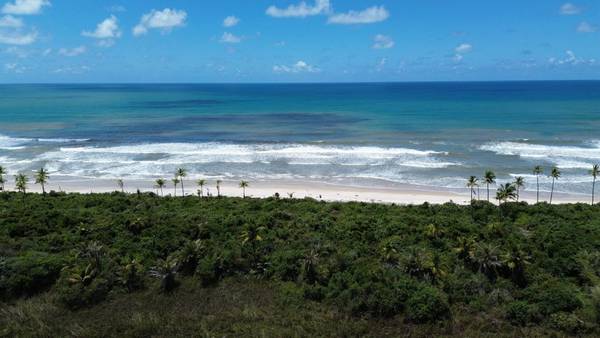
Past Pontal, the BA-001 heads south along a series of wide, straight beaches with coconut palms and open sea. This is where the beach houses, the gated communities and part of the city's hotels are concentrated — including the area known as Praia dos Milionários, where there are high-end houses in gated communities with sea views. The further south you go, the thinner the development, until Olivença, about twenty kilometres from the centre, an old village with waves sought out by surfers.
The south zone has the largest market for finished houses and is the one that most resembles a conventional second-home coast: easy access, the city nearby, the beach in front. It is also the zone where one of the most important legal questions in the whole region arises, explained further below.
The north zone: the BA-001 towards Serra Grande
North of the centre, the BA-001 runs between the sea and the forest, with long, lightly built beaches, rivers flowing into the sea and, inland, the Lagoa Encantada lagoon. This is the zone of smallholdings, large plots and beachfront farms — land that stayed unoccupied because, for decades, the money of Ilhéus was in inland cocoa and not on the coast. The whole stretch lies within the Lagoa Encantada and Rio Almada Environmental Protection Area, a state protected area created in 1993, which does not forbid building but regulates what may be built.
It is also the zone that may change most in the coming years, because of Porto Sul, planned for the district of Aritaguá, north of the city.
What is on the market
The Ilhéus market that reaches buyers from afar is small and very varied. Our selection reflects that and brings together three very different types of property.
Large beachfront estates
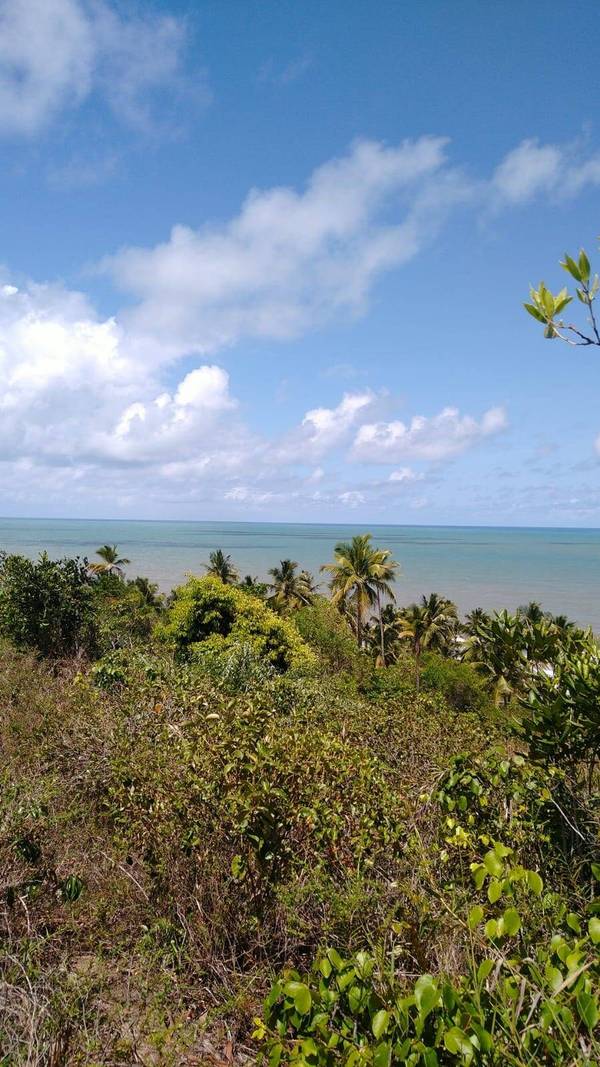
Farms and plots in the north zone with hundreds of metres of beach frontage, some crossed by the BA-001, with one part on the ocean side and another on the river side. These are properties intended for development — resort, gated community, subdivision — or for a private residence on the scale of an estate. In an area like this, the value is not in the hectares: it is in the sea frontage, in what environmental licensing allows to be built and in how long that licensing takes.
High-end houses in gated communities
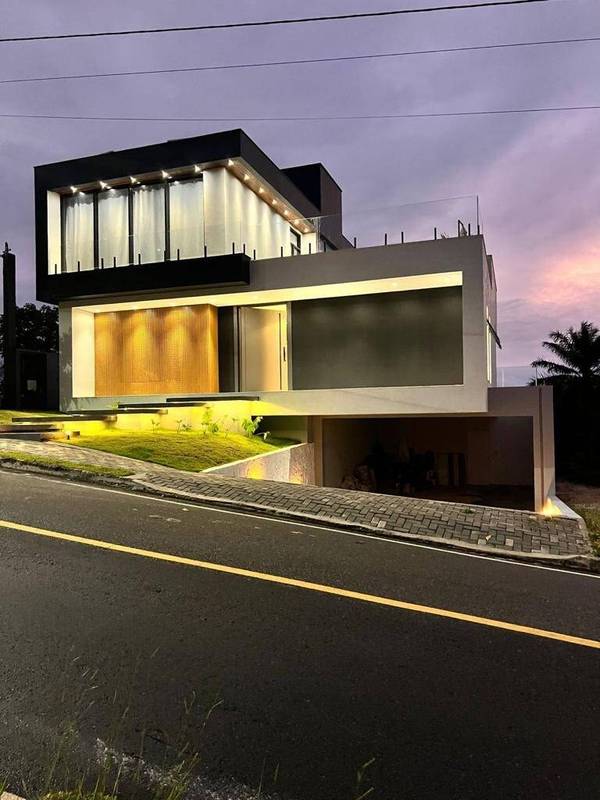
In the south zone there are new houses in gated communities with sea views, built with finishes that have little to do with the city's average standard: home automation, pool, suites with walk-in closets, cinema, garage for several cars. It is the product most similar to what is found in Trancoso or on the North Coast of Salvador, but in a city with year-round services.
Urban expansion areas
There are also large areas in expansion zones, near the airport and the city's growth corridors, with sea frontage and massing studies already done for real estate projects. These are purchases for developers, not for families.
About the advertised prices
Most of what is for sale here, in the segment that interests buyers from afar, has no published price: it is "on request". This is not carelessness — for beachfront farms and development land, the price depends on who is buying and for what, and the seller prefers to negotiate case by case.
This has a practical consequence: there is no reliable public reference for price per square metre for these products, and comparing with Itacaré or Trancoso is misleading, because the scale and possible use are different. The serious way to assess is to ask, together with the price, for the property registration, the georeferenced plan, what the protected area or the municipality allows on the land and, where they exist, any feasibility studies already done. A price without those documents cannot be compared with anything.
Porto Sul and the FIOL railway: what may change
The project that weighs most on the future of Ilhéus is Porto Sul, a port terminal planned for Aritaguá, north of the city, linked to the West-East Integration Railway (FIOL), which is meant to bring ore and grain from inland Bahia to the coast. Financing of R$ 6.59 billion for the port has already been approved by the council of the Merchant Marine Fund. The railway works between Ilhéus and Caetité, however, have been halted since April 2025, awaiting the transfer of the concession, and the original schedule — operation by September 2026 — has not been met.
For a property buyer, Porto Sul cuts both ways. If it goes ahead, it brings jobs, construction, demand for housing and commerce, and could revive the city's economy as cocoa did a century ago. It also brings heavy traffic, changes to the landscape and to artisanal fishing, and pressure on the north zone that does not always suit those who bought for the empty beach. If it keeps dragging on, the uncertainty remains. Either way, anyone buying in the north zone should know exactly how far they are from the planned port and railway.
Investment analysis
Appreciation
Ilhéus has not had the accelerated appreciation cycle of Itacaré or Trancoso. It has more supply, more city and less scarcity. That is a disadvantage for those expecting quick gains and an advantage for those who want to enter the southern coast of Bahia without paying the premium of the fashionable villages. The properties with the most appreciation potential are those that combine sea frontage, clean paperwork and an area the city's growth has not yet reached — and that potential depends, to a large extent, on what happens with Porto Sul.
Holiday letting
Holiday demand exists, above all in summer, at Carnival and during the July holidays, and it is largely regional: families from Itabuna, Vitória da Conquista and inland Bahia who come down to the coast. It is more seasonal demand, with a lower average value than in Itacaré. A high-end house in the south zone can earn well in January and stand empty for much of the year; that should be factored in before buying.
Exit
The resale market for high-end property in Ilhéus is narrow. A luxury house or a beachfront farm can take a long time to find a buyer, and the right buyer is often not local. Anyone buying here should assume a long horizon and not count on a quick exit.
Points to consider
The Tupinambá de Olivença Indigenous Land
In November 2025, the Ministry of Justice declared the Tupinambá de Olivença Indigenous Land to be in the permanent possession of the Tupinambá people, by Order No. 1075/2025. It covers about 47,376 hectares in the municipalities of Ilhéus, Buerarema and Una. This is the penultimate administrative step: the physical demarcation by Funai and the ratification by the Presidency of the Republic are still pending.
For anyone buying in the south zone, and especially in the Olivença area and inland from it, this is decisive. Property titles within a declared indigenous land can be annulled, with compensation only for improvements made in good faith, not for the land. Before any deposit, confirm whether the property is inside or outside the perimeter, with the property's georeferenced plan overlaid on the official map of the indigenous land. The seller's word is not enough, nor is the existence of an old deed.
Porto Sul still has no date
The port and the railway are the city's biggest promise and biggest uncertainty. Anyone buying in expectation of the appreciation the port would bring is buying a bet; anyone buying in the north zone for tranquillity should know the project may go ahead.
The protected area and environmental licensing
An environmental protection area allows building, but with rules: occupancy ratios, preservation strips along rivers and mangroves, restrictions on coastal scrub and on Atlantic Forest, which is protected by federal law throughout the country. On a beachfront farm, the difference between what one imagines building and what the environmental agency authorises can be huge — and it is that difference that decides the real value of the purchase.
Navy land and sea frontage
The strip of 33 metres measured from the mean high-tide line of 1831 belongs to the Federal Government. Seafront properties often have a part on this "navy land", registered with the Federal Heritage Secretariat (SPU), with an annual ground rent or occupancy fee and a transfer fee (laudêmio) on each sale. It is checked with the SPU, not in the deed.
Rural property and foreign buyers
Farms and rural land follow their own rules: the Rural Property Registration Certificate (CCIR), the rural land tax (ITR), the Rural Environmental Registry (CAR) and georeferencing certified by INCRA. The acquisition of rural property by foreigners is also subject to area limits and may require INCRA authorisation, under Law No. 5,709/1971. On a large estate, this is not a bureaucratic detail: it may determine whether the purchase is possible and in what structure.
Possession is not ownership
On the southern coast of Bahia there is a great deal of land occupied for generations without complete registration. A property only belongs to the seller if it is in the seller's name on the registration at the Property Registry Office; assignment-of-rights contracts, receipts and declarations of possession are not ownership. Ask for the full, up-to-date registration certificate before any payment.
It rains, and the roads feel it
The climate is humid tropical and it rains throughout the year. Dirt roads leading to farms and gated communities away from the BA-001 can become difficult in the rainy season, and humidity weighs on the upkeep of seaside houses. Visiting once in a dry period and once in a rainy period helps to understand what is being bought.
A mid-sized city, not a luxury destination
Ilhéus has services the neighbouring villages lack, but it does not have the high-end dining, shopping and services of a luxury destination. Anyone buying a high-end house here is buying a house above the city's average — which is good for peace and quiet and worse for resale.
Legal and tax checklist, in Brazil
Before buying: full, up-to-date property registration certificate; clearance certificates for the seller (civil, tax, labour); confirmation that the property lies outside the Tupinambá de Olivença Indigenous Land and other protected areas; enquiry to the SPU about navy land; for rural property, CCIR, ITR, CAR and georeferencing; for plots and houses, property tax (IPTU) with no arrears and, in a gated community, a clearance statement.
At purchase: public deed at the notary's office and registration at the Property Registry Office — without registration, the purchase is not complete. The municipal transfer tax (ITBI) is paid by the buyer before registration. Buyers from abroad need a CPF (Brazilian tax number) and usually an attorney in Brazil; money should come in through formal banking channels, so that the capital can be repatriated later.
While owning: annual IPTU or ITR, condominium fees where applicable, ground rent or occupancy fee where there is navy land, and maintenance — which by the sea and in a humid climate costs more than inland.
On sale: capital gains tax, laudêmio where there is navy land, and the time the resale market takes to respond.
Who it suits — and who it does not
It suits those who want the southern coast of Bahia with a city behind it: an airport minutes away, a hospital, shops and schools. It suits the long-horizon investor looking for a large beachfront plot in a region still to be developed and willing to do the licensing work. And it suits those who want a high-end seaside house without paying Trancoso prices.
It suits less those looking for quick appreciation, those who depend on year-round holiday letting, and those who do not want to deal with the paperwork the southern coast of Bahia demands — registration, indigenous land, navy land, protected area. Here, the right property exists; what separates it from the wrong one is rarely visible in the photograph.
Final thoughts
Ilhéus is in a moment of waiting. The bridge has already changed the south zone, the port may change the north zone, and the declaration of the indigenous land has changed the rules in part of the municipality. For buyers, this means real opportunities — sea frontage at prices that no longer exist in the neighbouring villages — and risks that are controlled with documents, not intuition.
For anyone wishing to go ahead, the path is simple to state and takes discipline to follow: know which Ilhéus you want to be in, demand the registration and a georeferenced plan before any deposit, and confirm on the official map what the land is.
When you contact us through a property page, we forward your enquiry to whoever has the complete information about that specific property — the registration at the registry office, the year's ITR or IPTU, the georeferencing where it exists and what licensing allows. The entire inventory is available in Portuguese, English, Spanish, French and Hebrew.