Homes for sale in Igrapiúna
Bahia, Brazil
About Igrapiúna
Igrapiúna lies in the Baixo Sul of Bahia, between Ituberá and Camamu, on the stretch of coast known as the Costa do Dendê, the oil palm coast. By land it is a municipality of forest, rivers and palm plantations, about five hours from Salvador. But its property market is barely on the mainland at all: it is on the islands of Camamu Bay, and this page is about them.
Camamu Bay is the third largest in Brazil, after All Saints Bay and Guanabara, and it holds more than a dozen islands. The offer in this market is concentrated on one of them, Ilha de Tubarões, about fifteen minutes by boat from Barra Grande. And there is a detail in the listings themselves that tells you everything about what you are buying.
When "it has a well and it has power" is a selling point
Look at what the listings here single out: electrical installation, artesian well, access by land or by boat. In a beachfront development that would be so obvious nobody would write it. Here it is written, because it is not a given.
Buying on an island in the bay means buying self-sufficiency. Water usually comes from a well, power has to be sorted out, the rubbish leaves with you, and there is no shop round the corner because there is no corner. There is no village on the island: there are houses, coconut groves, mangrove and water. Whoever understands that from the outset buys well; whoever discovers it after signing discovers it expensively.
In exchange, it is water unlike anything around it. This is a bay, not the open sea: no waves, no surf, the boat pulls up in front of the house and a child walks into the water without fear. It is the opposite of Itacaré's surf, and it is a choice, not a lesser version.
Where it is and how to get there
By land
From Salvador it is about three hundred and twenty kilometres, around five hours by car, on the BR-324 and then the BR-101, turning off onto the coast road. From Valença it is under sixty kilometres, about an hour. The town and the mainland strip are reached by car without difficulty.
By sea
The islands are reached by boat, and there are two doors. The first is the quay at Camamu, from where the boats serving the bay depart. The second is Barra Grande, on the Maraú Peninsula, about fifteen minutes by fast boat from Ilha de Tubarões. Out of season the crossing is arranged; in high season there is more traffic and more choice.
What that means in practice
It means the house has a timetable. You do not leave the island at any hour, the sea has days when it charges for the crossing, and everything that comes in — materials, shopping, visitors — comes in by water. Anyone buying here should make the crossing at least twice, one of them in bad weather, before deciding.
The areas, one by one
Ilha de Tubarões
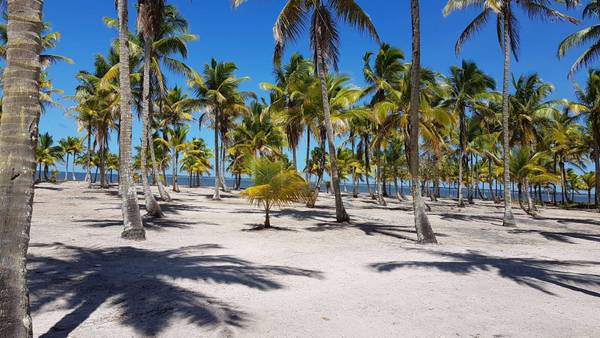
This is where the offer in this market sits. Plots with beach frontage measured in tens or hundreds of metres, coconut groves, mangrove at the back and houses set apart from one another. There are no shops and no services; there are neighbours, and the relationship with them counts for more than it would in a street. It is the most characteristic product of the municipality and the one that appears in our listings.
The other islands in the bay
Camamu Bay holds more than a dozen islands of every size, some with a settlement, others practically uninhabited. The formal market on them is small and irregular, and what comes up tends to arrive by word of mouth rather than by advertisement. Anyone looking for an island in this bay should look at the whole of it, not just at one name.
The mainland strip and the oil palm
On the mainland, the municipality is agricultural — oil palm, rubber, cocoa — with small settlements along the road. What changes hands is smallholdings and farms, not beach houses, and the paperwork is that of rural property, with the consequences dealt with below.
The hills and the protected forest
A significant part of the municipality's forest is protected, and by two different routes. The Pratigi Environmental Protection Area, created by the state in 1998, covers more than eighty-five thousand hectares in this region. And there is a remarkable private reserve: the Michelin Ecological Reserve, created in 2004 by the French company on its own plantations, which protects some four thousand hectares of Atlantic Forest, has already catalogued more than two thousand seven hundred species — some of them new to science — and holds the Pancada Grande waterfall, at sixty-one metres the tallest on the Bahian coast.
What is for sale
Seafront houses
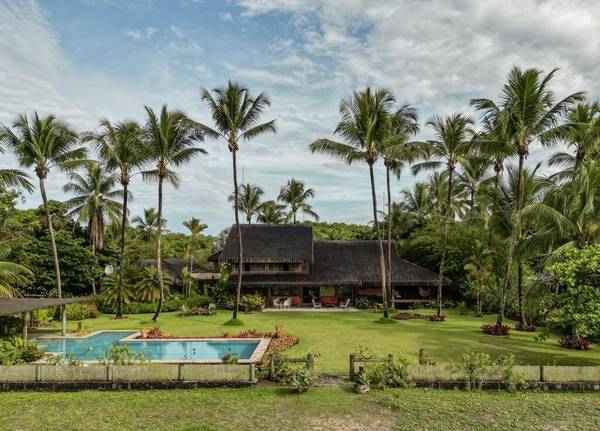
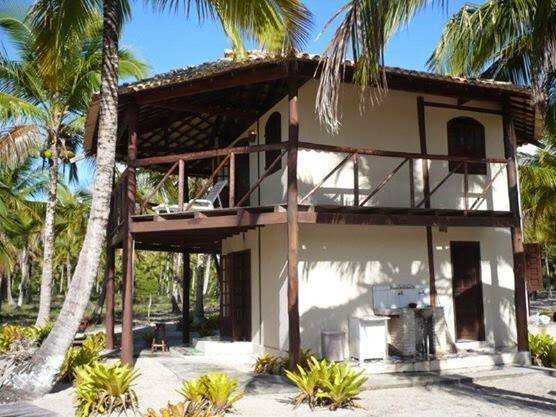
This is the main product, and it comes at two levels. At the top, high-end houses on large plots, with several en-suite bedrooms, a pool, a panoramic veranda and lawn running down to the beach — hundreds of square metres built, with access both by land and by boat. At the entry level, simple two-storey seafront houses with an artesian well, a coconut grove, fruit trees and room to build a second house on the same plot.
Land and plots with beach frontage
The other product is land. Large tracts appear, measured in tens of thousands of square metres, with hundreds of metres of beach frontage and an established coconut grove — sometimes with the option of being sold whole or divided into plots of a few thousand square metres, each with its own sea frontage. It is a way into the island without buying the whole tract, and it pays to read carefully how that division is made, because not every share is a plot with its own registered title.
About advertised prices
As elsewhere on this coast, it is common for the price not to be published. Many listings simply say "on request", and the figure comes out in the first conversation with the broker. It is not a sign of anything wrong; it is how the local market works, above all for land and for upper-end property, where the value depends on what is included.
Investment analysis
Appreciation
The bay rose in the wake of Barra Grande and the Maraú Peninsula: when access to that headland improved, the islands facing it found themselves fifteen minutes from an established destination instead of in the middle of nowhere. That is the engine. What appreciates here is the same as ever on this coast — clean paperwork, beach frontage and settled access — with a fourth factor peculiar to an island: installed infrastructure. Water, power and a good landing are worth far more in money than they appear.
Holiday rental
It works, but as a niche product rather than a volume one. An island house in the bay rents to people looking for exactly that: privacy, calm water and a boat. The useful year runs from December to March, with July and long weekends filling in, and management costs more than on the mainland because everything depends on someone going out there by boat. An honest calculation starts from the high season and deducts transport, management, maintenance and the salt air.
Exit
This is the weakest point of this market and it has to be said. The pool of island buyers is small, well informed and patient. A property with clean paperwork, infrastructure and access will sell; a subdivided plot without its own registered title, or a house with no settled water supply, can wait years. Here liquidity depends on the paperwork and the infrastructure, and the price barely corrects for it.
Points to consider
Who owns the ground on the seafront
Plots along the shoreline, and islands in particular, may sit on "terreno de marinha", federal Union land. In that case what is transferred is not full ownership but occupation or leasehold, registered with the Union's property authority, with an annual ground rent and a transfer levy on sale. That does not prevent buying or using, but it changes what you are buying and it changes the sums. On a tract with "three hundred metres of beach frontage", it is the first thing to confirm.
An advertised plot is not a registered plot
When a large tract is offered "whole or in plots", it is worth understanding whether those plots exist on paper or only on the drawing. Subdividing rural property has its own rules and requires approval; without it, what you buy is an undivided share, not a plot with its own title. The question is direct: does each plot have its own registered title, or will it, and when?
Possession is not ownership
Part of the land in this region was never properly titled: it changes hands as "possession", with private contracts and chains of assignment. Only a public deed registered on the property record, at the competent registry, transfers ownership. Buying possession is done, but it is a risk decision, with a discount on the price and with a local lawyer.
The protection area and the forest
Much of the municipality lies within an environmental protection area, and native vegetation falls under the Atlantic Forest Law. That limits clearing, earthworks and building on slopes, dunes and mangrove, and requires licensing for interventions that elsewhere would be routine. On an island, with mangrove at the back of many plots, this is no detail: what can be built is less than the plot appears to allow.
Building on an island
Every material crosses the bay by boat and lands without a cargo quay. That raises building costs in ways a mainland budget does not foresee, stretches timescales and limits what is possible. Labour comes and goes by boat, and the salt air demands ironmongery and window frames that elsewhere would be excessive. Anyone buying land to build should budget with wide margins and count on someone trustworthy supervising.
Healthcare and emergencies
There is no medical care on the island. A serious case leaves by water, for Camamu or Valença, and the time depends on the sea and the hour. It is not a reason not to buy — it is a reason to have a boat, fuel and a plan, and to weigh it calmly if you are thinking of living here year-round.
Rain and seasonality
This is one of the rainiest stretches of the country's coast, with the rain concentrated between March and July. A house left closed without ventilation grows mould within weeks, the dirt roads on the mainland side deteriorate and the sea has more closed days. Outside the high season, the bay is practically empty.
Legal and tax checklist, in Brazil
Before buying
- Up-to-date registration record and a reading of the chain of title: the seller must be the person on the record.
- Confirmation of whether the property sits on Union land and, if so, under which regime and with what charges.
- If it is a share of a larger tract: whether the subdivision is approved and whether the plot has or will have its own registered title.
- If rural: registration with INCRA, the Rural Environmental Registry, georeferencing and the legal reserve.
- Water, power and access: source, well licence, electrical connection and right of way, in writing.
- Clearance certificates for the seller and the property, and rural or municipal property tax paid up as applicable.
At purchase
A foreigner buys urban property in Brazil without restriction, needing only a CPF tax number; for rural property there are limits and additional requirements, and a non-resident individual as a rule cannot acquire. The normal route is a purchase agreement, payment of the municipal transfer tax, a public deed at a notary and — the step so many forget — registration on the property record. Where there is Union land, there is also the transfer with the Union, with its own timescale and cost.
While you hold it, and on sale
Annual rural or municipal property tax, ground rent where the land belongs to the Union and, for tax residents, declaration of the asset. Anyone renting out declares the income and, as a non-resident, is subject to withholding at source. On sale there is capital gains tax and, on Union land, the transfer levy. Remitting funds abroad requires that the money's entry was registered with the foreign exchange authorities at the time of purchase.
Who it suits — and who it does not
It suits those who want calm water, real privacy and a boat at the door, and who know that comes with compulsory self-sufficiency. It suits those who already know Barra Grande and the Maraú Peninsula and have realised that across the water there is the same sea at another price. And it suits those who buy with the infrastructure already sorted, or with the money and patience to sort it.
It does not suit those who need shops, services or healthcare nearby. It does not suit those who want steady income, because this is a niche product. And it makes no sense at all to buy beach frontage on an island without knowing who owns the ground and without seeing how you get there on a bad-weather day.
Igrapiúna compared
Against Maraú, on the other side of the same bay, you trade the open-sea beach for calm water and gain privacy; Barra Grande has a village, shops and restaurants, and the island has none of that. Against Cairu, with its islands of Morro de São Paulo and Boipeba, it is far less touristic and far less served — there you have whole villages, here you have scattered houses. Against Itacaré, it is more isolated and cheaper, and it has no surf and no nightlife. Against Praia do Forte, it is the opposite extreme in everything: no infrastructure and no crowds.
Due diligence specific to the bay islands
Beyond what has already been said, four checks are worth more here than anywhere else. The first is to go out to the island on two different days, one of them with a choppy sea, and time the real crossing. The second is to see the water and the power working, not to be told they exist: turn on the tap, look at the well, look at the fuse board. The third is to confirm how you land at low tide, because a good landing at half tide can be unusable at other hours. The fourth is to ask a neighbour what his last building job cost and how long it took — it is the information no listing brings and that decides whether the project is viable.
Final considerations
Among the houses and land for sale in Igrapiúna, what exists is on the islands of Camamu Bay, and it is a small, specific market for people who know what they want. The compensation is rare: calm water, your own beach frontage and a silence that has all but vanished from the Bahian coast within easy reach. On land, the same municipality holds protected forest and the tallest waterfall on Bahia's coast, which says a good deal about the kind of place it is.
What separates a good deal from a bad one here is not in the photographs — it is in the registration record, in where the water comes from, and in the bad-weather day. For anyone who wants to go ahead, the path is simple to state: confirm who owns the ground before talking about price, demand the registration record before any deposit, and cross the bay in February and in June before signing.
When you contact us through a property page, we forward your enquiry to whoever holds the full information on that specific property — the year's rural or municipal property tax, the title registration, the standing with the Union where the land is federal and the status of any outstanding financing. The whole inventory is available in Portuguese, English, Spanish, French and Hebrew.