Homes for Sale in Costa do Sauípe – BA, Brazil
Bahia, Brazil
About Costa do Sauípe
Costa do Sauípe is a name that refers, at the same time, to a stretch of beach and to a development. It lies at the northern edge of the municipality of Mata de São João, on the northern coast of Bahia, about 76 km from Salvador, and it did not come into being the way the villages around it did: it came out of an investment decision, in the year 2000. What exists here — the internal roads, the hotels, the shops, the managed beachfront, the residential gated communities — exists because a tourism complex was built from scratch across 176 hectares of coastal scrubland.
Anyone who buys a house in Costa do Sauípe is buying inside that complex. That is not a brochure detail: it sets the annual cost, it sets how liquid the property is on resale, and it makes the value of the house depend, in part, on decisions that are not the owner's. It is different from buying in Praia do Forte, which is a village with a life of its own, and it is the opposite of buying in Diogo, which is a hamlet at the end of a dirt road. Here the convenience is far greater and the autonomy is far smaller. It is worth understanding before looking at any listing.
Where it is, and what exactly is called Costa do Sauípe
Access is via the BA-099, the highway known as the Linha Verde, which leaves Salvador and follows the coast northwards. It is roughly 76 km and around an hour and a half by car, depending on traffic leaving the city. Salvador's international airport lies on the way, which shortens the journey considerably for anyone arriving by air. Unlike much of this coast, the route is paved the whole way to the entrance of the complex — there is no dirt section, and here that is a genuine selling point.
A common confusion of names is worth clearing up. Costa do Sauípe, in Mata de São João, is the complex and the beachfront in front of it. Porto de Sauípe is something else: a fishing village in the municipality of Entre Rios, some twelve kilometres further north, with a different type of property and a different price level. Anyone searching for one and ending up looking at listings for the other is comparing things that do not compare. The Sauípe River, which gives both their name, runs nearby and is the geographical reference that separates the two sides.
Inside the complex, the seafront runs for about six kilometres and is divided into beaches of distinct character: one more sheltered, with natural pools at low tide, one central and busier, and one more open and deserted, favoured by surfers and by people walking at the end of the day.
The complex, and what happened to it
This is the part almost no listing tells you, and it is the part that weighs most on a purchase decision.
Costa do Sauípe opened in October 2000, the result of a partnership between Previ, the pension fund of Banco do Brasil employees, and Odebrecht, with an investment of around R$ 340 million. It opened as the largest hotel complex in the country, with five hotels, more than fourteen hundred rooms and a village of themed guesthouses. It hosted the tennis tournament that was for years Brazil's leading event on the international circuit, and it hosted the final draw for the 2014 World Cup, in December 2013 — which gives the measure of the scale and the international visibility the place once had.
It also had the other half of the story. The complex ran up losses: in 2016 alone the negative result was around R$ 29 million. In November 2017 Previ sold the whole thing for approximately R$ 140.5 million, and since 2018 the complex has belonged to the Aviva group, the same group that operates Rio Quente, in Goiás.
The current cycle is one of investment. The group has announced a plan of around R$ 1.2 billion through to 2028 across all of its operations, of which some R$ 420 million is earmarked for refurbishing the Sauípe hotels — which have been reopening progressively after major works. A large water park is under construction, covering more than a hundred thousand square metres and themed around sea-turtle conservation, scheduled for 2027. The tennis tournament has returned to the international calendar.
Why tell this on a property page? Because the value of a house here is, to a large extent, a derivative of the complex. When the complex was stalled, the residential market around it was stalled. The investment cycle now under way is the reason it makes sense to look at Sauípe now — and it is, at the same time, the reason to buy with the construction calendar in hand rather than with the brochure photograph.
What is on the market here
Inventory in Costa do Sauípe looks nothing like a city's, and nothing like a beach village's either. There are no blocks on the seafront, no shopping streets with flats above them. What circulates falls, essentially, into three families.
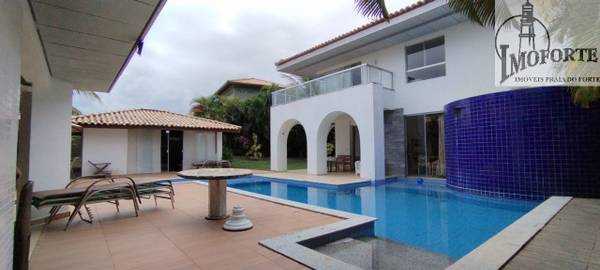
Houses in gated communities. This is the dominant product. Quintas de Sauípe is the best-known residential address inside the complex: single-storey or two-storey houses, often sold furnished, with a pool and an outdoor kitchen, on plots that typically run from a few hundred to more than a thousand square metres. The community has its own club, with a pool, a gym, a sauna, courts and a children's area.
Plots in gated land developments. There is land for sale in plot developments in the region, with areas generally between four hundred and a thousand square metres, with underground services and beach access. It is the route for anyone who wants to build to their own design — and it is also the one that demands the most prior checking, for the zoning reasons explained below.
Units aimed at rental income. Apartments and houses intended for seasonal letting, supported by the visitor flow of the complex itself. It is a real product, but with very marked seasonality, and it deserves a calculation made with full-year figures.
In our own selection, a ready-built five-bedroom house in a gated community inside the complex sits today at close to R$ 2.35 million. That figure says more than it appears to: here the price is not explained by built square metres, as it would be in a city, but by three variables — which community the house is in, the distance to the sea, and the real condition of the building after years of salt air. Two houses with the same floor area in the same community can be worth quite different amounts because of that third variable.
The Northern Coast Environmental Protection Area — what it means in practice
This entire coast lies inside the Área de Proteção Ambiental do Litoral Norte da Bahia, a strip roughly 10 km wide and 142 km long, covering approximately 142,000 hectares across Mata de São João, Entre Rios, Esplanada, Conde and Jandaíra. The protection area was created precisely because opening the Linha Verde highway would put development pressure on ecosystems that were — and largely still are — well conserved.
Being inside a protection area does not mean you cannot build. It means occupation is regulated by an Ecological-Economic Zoning plan, with zones of sparse occupation and zones of visual protection, governed by CEPRAM Resolution 1.040/95 and by state Law 11.476/2009, which deals with tourism development inside environmental protection areas.
In Costa do Sauípe, most of what is for sale sits inside developments that are already licensed, and that reduces the risk considerably compared with a standalone plot on the same coast. It reduces it; it does not remove it. A plot inside an approved development is still subject to its own restrictions — footprint, height, setbacks, clearing of vegetation — and what the community permits is not necessarily what the buyer's plan imagines. The question “what exactly can I build on this plot?” is asked in writing, of the municipality and the state environmental body, before the deposit.
The same logic applies to what is already built. An existing building does not, by itself, prove it was licensed, nor that extensions added after handover were approved. Enclosed verandas, outbuildings and pools added later are the most common case, and they enter the price calculation only once confirmed.
The sea, which is not the one on the postcard
This is the point that most often surprises buyers at a distance, and it is fair to say it plainly: the sea at Costa do Sauípe is rough most of the time. The coast is exposed, the waves are strong, and there are stretches where swimming is not advisable. Calm bathing happens mainly at low tide, when natural pools form among the reefs, and it concentrates on the more sheltered section of the seafront.
That explains why life in the complex is organised around pools, clubs and leisure facilities rather than around the water's edge, as it is on other beaches in the Northeast. It is not a hidden defect — it is the nature of the place, and some people prefer it that way. But anyone buying while picturing a routine of swimming every morning should visit at two different tides before deciding.
Infrastructure, day to day
Inside the complex there is a services hub, with restaurants, shops, a pharmacy and a bank branch, built to serve the traffic of the hotels. It covers the essentials and it covers the unexpected, but it was designed for guests, not for stocking a house lived in all year round.
The routine of a family — the big supermarket, maintenance purchases, services — is handled in Praia do Forte, about thirty kilometres to the south, or in the town of Mata de São João. For serious healthcare, the reference is Salvador. In practical terms that means a car is essential and a planned trip once or twice a week. For a second home it is perfectly manageable; for permanent residence with school-age children, it is a factor to weigh seriously before buying.
The neighbourhood: Praia do Forte, Imbassaí and Porto de Sauípe
Costa do Sauípe cannot be valued in isolation. The stretch running from Guarajuba up to Entre Rios works as a single market, with distinct price levels:
Praia do Forte, in the same municipality, is the established destination of the region, home to the national visitor base of the TAMAR sea-turtle project, with established hotels and gated communities dating from the 1990s. It is the village that gives the northern coast its name in the international market, it is where the real commerce is, and it is the highest price level on the stretch.
Imbassaí grew around the river that runs parallel to the sea before reaching it, and today has a meaningful supply of guesthouses and holiday homes, with a more informal character.
Porto de Sauípe, already in Entre Rios, is the fishing village north of the complex, with clearly lower prices and much simpler infrastructure.
Sitting among those names is what sustains demand for Sauípe. It is also what limits it: those who want a village with urban life buy in Praia do Forte, and those who want village prices buy in Porto de Sauípe. Sauípe sells something else — the infrastructure of a complex and the security of a gated community, at a point on the coast that, without the complex, would be scrubland.
The cost of keeping it
With a second home by the sea, the bill that surprises people is not the purchase — it is the upkeep. Here it has four parts, and the first is the one that sets Sauípe apart from the rest of this coast.
The community fee. Unlike a standalone house in a hamlet, a house in a gated community pays a monthly charge covering security, upkeep of common areas, the club and infrastructure. It is a known and predictable figure, and it is the direct counterpart of what you buy here. Ask for a statement of the last twelve payments, and ask about extraordinary levies approved or under discussion — major works in communities more than twenty years old are the most common source of surprises.
Salt air. Less than a kilometre from the sea, anything metal suffers. Fittings, hinges, gate structures, air-conditioning condensers, poorly treated aluminium frames. Exterior paint lasts less than it would inland, and exposed timber needs treatment far more often. This is not a construction defect: it is the condition of the site. In a twenty-year-old house, the difference between one that was maintained and one that was not is the difference between a cosmetic refurbishment and replacing the installations.
Vegetation. In a hot, humid climate, on a plot with a garden, the bush comes back fast. Land left alone for three months does not look like the land that was visited. That means a regular maintenance service, and that cost belongs in the calculation before the purchase, not after.
The empty house. A property closed for most of the year needs someone nearby — to open it, air it, check for damp after the rains and deal with a roof problem before it becomes a ceiling problem. In a gated community that is easier to arrange than in an isolated house, but it is still a contracted service, not a favour.
Points to consider
The golf course closed — and still appears in listings
The complex had an 18-hole golf course, opened with the development in 2000 and designed by Brian Costello. It closed in April 2015, after years of losses, and never reopened. Property descriptions, aggregator sites and older material still advertise “house in a gated community with golf course”. In most cases it is not bad faith — it is text that was never updated. But it is the clearest example of the general principle of this page: an amenity quoted in a listing is confirmed today, not in the brochure.
The value depends on one operator
Sauípe's strength is also its concentration of risk. The activity, local employment, services and the outside perception of the destination depend to a large extent on the performance of a single group. That has cut both ways already: there was a decade of stagnation, and there is now an announced investment cycle. Anyone buying should be aware that they are taking a position on that cycle.
The water park construction
The park scheduled for 2027 is probably the largest value driver in sight for the region. It is also a major construction project lasting years. It is worth asking where the site is in relation to the property, what the service access routes are and what the planned timetable is — information the seller may not have and which is sought from the community management and the municipality.
Zoning, before price
Being inside a licensed development reduces the risk, but what each plot allows still depends on the protection area's zoning and on the community's own rules. Buying land with a project in mind without confirming in writing what it permits is the most expensive mistake available on this coast.
Paperwork
On this stretch of the Bahian coast it is common to find discrepancies between the registered area and the real one, incomplete chains of ownership, or pending regularisation. In a gated community the picture is usually cleaner than on a standalone plot, but it is not skipped: an up-to-date registry record, clearance certificates for both seller and property, a statement that community fees are settled, and a check for any incidence of federal shoreline land.
Seasonality
Activity concentrates in summer, on long weekends and at weekends, and the complex's events calendar shifts demand to specific dates. Anyone buying on the expectation of seasonal income should project the year using the region's real occupancy, not January's multiplied by twelve.
The rainy season is mid-year
On the coast of Bahia the wettest period runs, broadly, from April to July — it is not the dry climate many people associate with the Northeast. It is the best time to view a property: it is when damp, leaks, poor drainage and the true state of the roof reveal themselves.
Liquidity
This is a small market, with few transactions a year and a limited number of price references to compare against. Resale tends to take longer than in an urban market, and the typical buyer comes from outside the state. Anyone buying here should assume a long horizon.
Who Costa do Sauípe works for
It works well for anyone who wants a second home by the sea with ready infrastructure and the security of a gated community, without having to solve water, access, security and maintenance on their own. It works for families with children, precisely because life is organised around a club and a pool and does not depend on a sea that is not always fit for swimming. And it works for anyone who reads the investment cycle now under way as a thesis: buying into a destination in recovery rather than one already mature.
It does not work for anyone seeking autonomy and isolation — for that, Diogo and the Imbassaí stretch answer better and for less money. It does not work for anyone who wants urban convenience within walking distance. And it does not work for anyone who needs to resell quickly.
Before closing a deal
A short list, in the order that makes sense to work through it:
1. Confirm in writing, with the community management and the municipality, what the plot or the house allows — including extensions already built.
2. Request the up-to-date registry record and certificates, and compare the registered area with the real one.
3. Ask for the last twelve community fee statements, the minutes of the last general meeting and information on extraordinary levies.
4. Check what is actually operating in the complex today — not what the listing description says.
5. Visit at two different tides, and preferably outside the summer.
6. Confirm water supply, electricity and sanitation for the plot, and who operates them.
7. If the plan is income, establish real occupancy in the region outside the high season.
Browse our selection of properties in Costa do Sauípe. When you contact us through a property page, we forward your enquiry directly to the agent responsible for that property, who knows the community, the paperwork and the history of the negotiation.