Homes for sale in Celebration
Florida, USA
About Celebration
Celebration is an invented town. Not in the sense of fake — more than eleven thousand people live there, with schools, a hospital, shops and named streets — but in the literal sense: it was drawn on a drafting table by the Walt Disney Company, on land that Walt Disney and his team had quietly bought in the late 1960s, and its first residents moved in in 1996. It is one of the best-known experiments in "New Urbanism" anywhere: a town of front porches, wide sidewalks, houses close to the street and a centre you walk to, built from scratch next to Walt Disney World. The master plan is by architects Robert A. M. Stern and Jacquelin T. Robertson, and the idea was to show that, at the end of the twentieth century, an American town could be built the way they were at the beginning of it — with the school, the post office, the bank and the cinema within walking distance of home.
Disney gave up control of the town in the mid-2000s, and today everything is privately owned. But the design remained, and with it the rules — which are the most important thing a buyer has to understand before looking at any house here. Celebration is not just another Orlando suburb with a pretty name: it is a planned community with associations, covenants and restrictions that decide what can be done with a property. This page explains what the town is, where what is for sale is located, and what those rules mean in practice.
Where it is and how to get there
Celebration is in Osceola County, Central Florida, against the southern edge of the Walt Disney World property and next to Kissimmee. Technically it is not a municipality but a census-designated place, a locality recognised by the census and administered by the county. According to the 2020 census, it had 11,178 inhabitants.
Location is the first argument: the Disney parks are a few minutes away, Interstate 4 runs alongside and connects to Orlando and Tampa, and US-192 connects to Kissimmee. Orlando International Airport is about half an hour away, depending on traffic. For those who live here and work in the region, I-4 is both the advantage and the problem: it is the road that goes everywhere, and it is also one of the most congested in Florida.
The town, area by area
The centre: Market Street and the lake
Celebration's centre is small — a few blocks around Market Street and Front Street, with shops, restaurants, fountains and a boardwalk along Lake Rianhard. It is the heart of the original design and the place where the town looks most like a set and least like a suburb. On weekends and in holiday seasons it fills with visitors, which is good for business and less good for those who live a few steps away.
The original villages
Around the centre spread the villages built since the mid-1990s — North Village, West Village, South Village, Lake Evalyn, Artisan Park, Aquila Reserve and others — with houses in traditional American styles, apartments and townhouses, and large houses around the golf course. This is where most resale homes are, of very different ages and conditions: a 1998 house and a 2015 house on the same street can have very different maintenance costs.
Island Village, west of I-4
The newest part of Celebration is Island Village, at the western edge, between World Drive and I-4, bordering Disney land to the north. It is a development by the builder Mattamy Homes, with more than a thousand homes planned — single-family houses and townhouses — and its own pool, clubhouse, trails and conservation areas. It is part of the Celebration community, with the Celebration address, schools and governance, but it lies on the other side of the interstate: to reach Market Street you cross I-4 by a bridge.
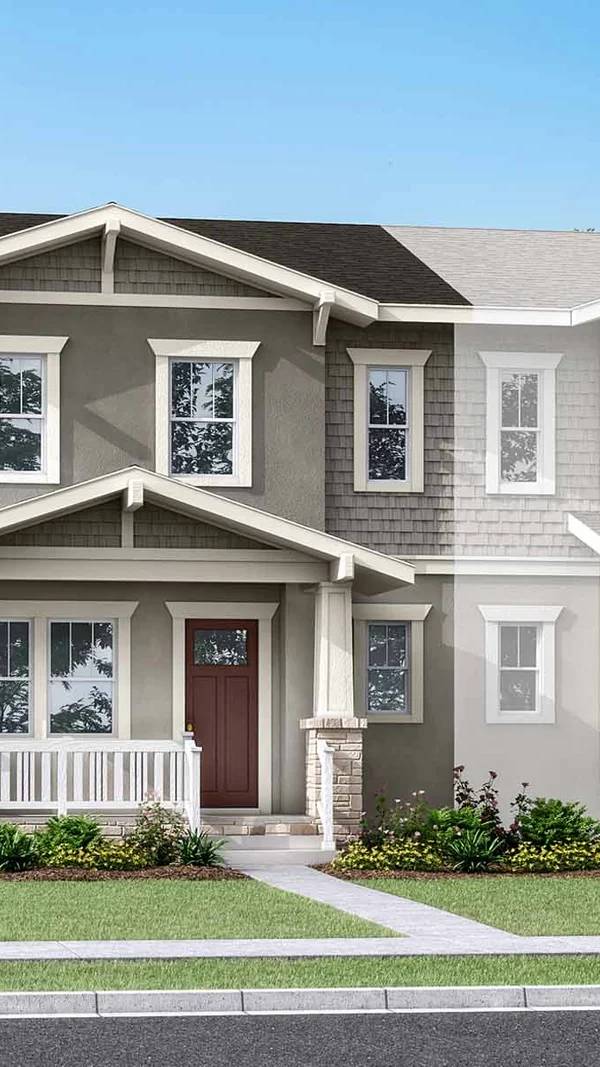
It is in Island Village, on Estuary Lake Loop, the development's own address, that you will find what our selection holds in Celebration: new construction, at the entry level of the development.
What is for sale and at what price
Celebration is expensive for the region. In 2026, the median sale price ranged between about US$ 590 thousand and US$ 680 thousand, depending on the month and the source, with large differences by property type: condos from just over US$ 200 thousand, townhouses around US$ 600 thousand, and single-family homes with a median near US$ 900 thousand.
In Island Village, Mattamy's new homes have been advertised from about US$ 580 thousand to US$ 1.89 million, depending on size and lot.
Buying new from a builder is different from buying a resale home. The list price is a starting point, and builders negotiate more with incentives — closing costs, interest rate, upgrades — than with a straight discount. The house comes with the builder's warranties, but the buyer chooses among the plans and lots available in that phase, and what the listing shows is not always the exact house being bought: it is worth confirming the lot, the plan and the delivery date in writing.
The rules that decide everything
The associations and the fees
Anyone buying in Celebration becomes a member of the Celebration Residential Owners Association (CROA), the master association, and often also of a village or condominium association, with its own fees and rules. There is also a Community Development District (CDD), a special public entity that finances and maintains infrastructure and, in some areas, levies an assessment that appears on the property tax bill. Costs vary a great deal from one street to the next; added together, they can range from a few hundred to several thousand dollars a year. The rule is to ask, before making an offer, for the exact list of associations and fees for that lot.
No renting by the week
This is the rule that most surprises people who arrive thinking of Disney. CROA covenants prohibit, in most of Celebration, rentals of less than 30 days, and some villages require minimum leases of six months or a year. In practice, there is no legal short-term rental in Celebration's residential areas. Anyone wanting a house to rent to tourists by the night or by the week should look in other parts of Osceola County where this is allowed — not here.
Long-term renting is permitted, with minimum terms that vary by area and, in some cases, with registration and association approval.
Covenants on appearance and use
The rules also cover façade colours, gardens, fences, exterior alterations and even where you park. For those who like order, this is an advantage: it is why the streets still look the same thirty years later. For those who want freedom to change the house, it is a limitation worth knowing about before buying.
Investment analysis
Appreciation
Celebration has a well-known name, a location that cannot be repeated and a supply limited by its own design, which has kept prices above the regional average. But the Central Florida market cooled after the years of strong gains, and in 2026 some measurements showed the median below the previous year. Island Village adds many new homes at once, and that weighs on the resale of the newest houses while the builder is still selling.
Income
With short-term rentals prohibited, the possible income is from long-term renting, to families working in the region — including at AdventHealth Celebration hospital and in the tourism industry itself. It is steadier and lower income than a holiday home's, and it has to be calculated after association fees, property tax and insurance.
Exit
Celebration has its own demand, from families who want to live there, and that helps with selling. But it is an end-buyer market, not an investor market: sellers have to compete with the builder's new homes and the rest of the region's supply, and should allow for the months that takes.
Points to consider
The short-term rental ban
This is the point to confirm first, with the CROA and village covenants for that lot, before any offer. A business plan based on renting to tourists does not work here.
Several layers of fees
CROA, village association, any condominium and the CDD add up. The real figure is only known with the documents for that specific lot — and it should go into the income and mortgage calculations, not be discovered after closing.
Property tax and the exemption that does not apply
In Florida, the homestead exemption and the 3% cap on the annual rise in taxable value apply only to the primary residence of someone who lives there. A second home or a rental property pays the full property tax, with a looser cap on increases. On a new house, the first year's taxable value may be low, because it still reflects only the land — and rise considerably the following year, when the house enters the assessment.
Insurance, hurricanes and water
Central Florida is far from the coast and the storm surge, but not from hurricane winds or heavy rain. Home insurance has risen sharply in the state in recent years, and houses near lakes and wetlands — of which Celebration has many — should have their FEMA flood zone confirmed before purchase. Get an insurance quote before making an offer, not after.
New home, phase under construction
Buying in a phase still under construction means living for a few years with trucks, dust and noise, and depending on the builder's delivery date. Confirm in writing the schedule, what is included in the price and what is a paid option.
The other side of I-4
Island Village is Celebration, but it is not Celebration's centre: you reach Market Street by car or bicycle, crossing the interstate. Anyone buying for the charm of the walkable town should know which side of I-4 the house is on.
A town with rules for almost everything
The covenants that keep Celebration attractive also limit what can be done. Reading the CROA declaration and the village declaration before buying is not bureaucracy: it is knowing what you are buying.
Legal and tax checklist, in the US
Before making an offer: the full list of associations and fees for that lot; the CROA and village declarations, with the rental rules; CDD status; FEMA flood zone; insurance quote; for a new home, the builder's standard contract, the delivery schedule and the warranties.
At purchase: closing is handled by a title company or an attorney, with title insurance. Foreign buyers can buy without restrictions, but financing for non-residents is more expensive and requires a larger down payment. Money should come in through formal banking channels.
While owning: annual property tax, association fees, insurance and maintenance. Rental income for a non-resident owner carries its own tax obligations in the US.
On sale: when the seller is a foreign person, FIRPTA withholding generally applies to the sale price, to be settled later on the tax return, and capital gains tax follows federal rules.
Who it suits — and who it does not
It suits those who want to live in Central Florida with schools, a hospital and a real town centre, minutes from Disney and the airport. It suits families moving to the region, those looking for a second home for their own use, and the investor who accepts long-term renting as the model.
It suits less those who want a holiday home to rent by the week — the rules do not allow it —, those who do not want to live under association covenants, and those looking for the lowest price per square metre in the region: at that price, there is plenty of supply in Kissimmee and St. Cloud.
Final thoughts
Celebration is a rare product: a town thought out in detail, with a recognisable name and a location that cannot be repeated. The price pays for that, and it also pays for the rules that keep everything as it was designed. Anyone buying here buys both at once, and should know that the rule that weighs most — no short-term renting — is the first one a tourist imagines breaking.
The path is simple to state: decide whether the house is for living in or for long-term renting, ask for the covenants and fees for that lot before any offer, and confirm the insurance before closing.
When you contact us through a property page, we forward your enquiry to whoever has the complete information about that specific property — the associations and fees for the lot, the rental rules, the builder's delivery schedule and the tax history. The entire inventory is available in Portuguese, English, Spanish, French and Hebrew.