Homes for Sale in Camaçari – BA, Brazil
Bahia, Brazil
About Camaçari
Camaçari is two things at once, and anyone looking for property here needs to know which of them they want. Inland, it is a mid-sized industrial city in the Salvador metropolitan region, home to the largest integrated industrial complex in the Southern Hemisphere. Facing the Atlantic, it is a strip of forty-two kilometres of beaches with seven holiday settlements, linked to Salvador by a fast paved highway.
The two Camaçaris share a name, a municipality and almost no property market. This page is about the second — but the first explains the second more than it seems, and that is where to start.
Salvador's weekend coast
The difference between this coastline and the beaches of southern Bahia is one of kind, not of degree. Itacaré, Boipeba and Maraú are destinations: they live off tourism, you arrive to stay a week and the economy works in seasons. Camaçari is something else: it lies about fifty kilometres from Salvador, by motorway, and it is where the city goes on Saturday.
That explains the product you find here and do not find further south: gated communities with a manned gate, houses delivered finished, paved streets, stable power, a supermarket ten minutes away. And it explains the calendar: the house fills at weekends and on public holidays, empties on Tuesday, and the year divides not into high and low season but into weekdays and weekends.
Anyone buying in the hope of a fishing village is buying the wrong place. Anyone buying a second home fifty minutes from their first is buying exactly what this strip does better than anywhere else in Bahia.
The other Camaçari, and why it matters
The Camaçari Industrial Complex opened in 1978 and was the country's first planned petrochemical complex. It now brings together more than ninety companies and is the largest integrated industrial complex in the Southern Hemisphere. Beside it, the Ford plant operated for two decades until the company ended its Brazilian operations in 2021; part of that site later took the BYD plant, with an announced investment in the billions of reais to build electric and hybrid vehicles, trucks and battery components.
For a beach-house buyer this is not trivia: it is what underpins demand. There is a rental and sales market fed by people who work at the complex, there is local income that does not depend on tourists, and there are services that simply do not exist on other Bahian beaches. It is also why this municipality has the roads, the sanitation and the scale that a destination village does not.
The complex sits inland, well away from the beach strip. Even so, it is worth knowing where a property stands in relation to it — any local broker will tell you, and it changes how a neighbourhood reads.
Where it is and how to get there
Access is by the BA-099, the Estrada do Coco, built in 1975, which starts beside Salvador's international airport and runs to Praia do Forte, where it becomes the Linha Verde. It is a good toll road, and it is the reason this coast developed the way it did.
From the airport to the first settlement is a matter of minutes; Arembepe is about twenty-five kilometres away. From Salvador to the town centre is about fifty kilometres. In practice almost the whole strip is under an hour from the airport, which is decisive both for buyers coming from abroad and for anyone renting out.
The seven coastal settlements
The municipality's coast is organised into seven settlements, running north from Salvador. Each has its own market, and the price gap between them is wide.
Abrantes, Busca Vida and Interlagos
This is the southern end, closest to Salvador and the most urban. Abrantes is historically where Portuguese colonisation reached this region, with Jesuits settling there in 1558, and it holds one of the largest dune complexes on the northern coast of Bahia, with its own park. Busca Vida and Interlagos are established gated communities of large houses, where some of the municipality's highest-end product appears.
Jauá
A built-up, popular beach with coconut groves and natural pools at low tide. It is among the most affordable parts of the whole strip, and among the busiest at weekends.
Arembepe
About thirty kilometres from Salvador, this is the settlement with the strongest identity of its own: the hippie village of the nineteen-seventies left its mark, and the place keeps a small scale, with a river, coconut groves and reefs. It hosts the Tamar sea turtle project, which says a good deal about the kind of beach it is.
Barra do Jacuípe
Defined by the meeting of the Jacuípe river with the sea, with a stretch of dense coconut grove that is among the most beautiful on this coast. It is more residential and quieter than Jauá, and sought by those who want river and sea on the same plot.
Guarajuba
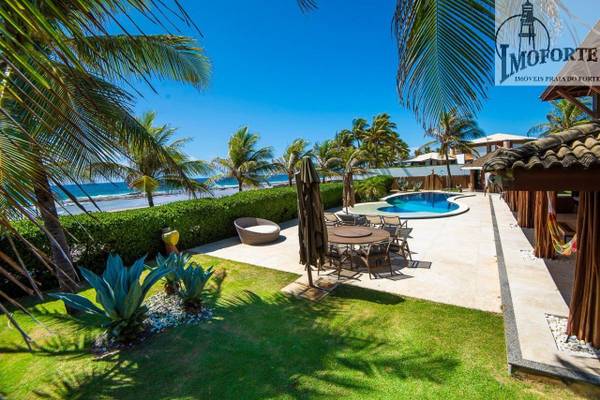
This is the municipality's most established address for high-end second homes, organised almost entirely into gated communities. The beach holds the international Blue Flag award, which certifies water quality, safety and facilities — and which is rare on Brazilian beaches. Much of our offer in this municipality is concentrated here.
Itacimirim
The last beach on the Estrada do Coco before Praia do Forte, where the Pojuca river meets the sea beside reefs that form pools at low tide. It has its own high-end market and is covered in detail on its own page.
What is for sale
Houses in gated communities
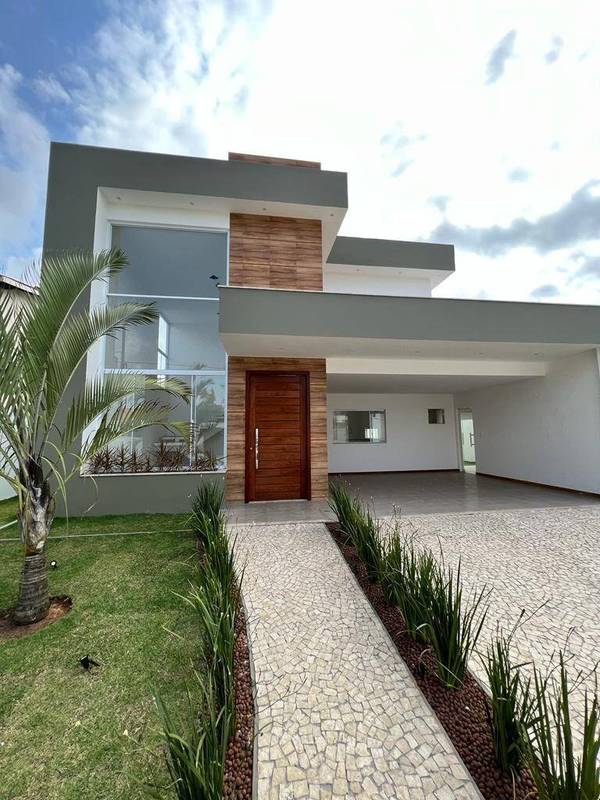
This is the dominant product and what defines the strip. They range from newly delivered villages of three or four en-suite bedrooms, with a private pool and an outdoor kitchen, to large residences of six, seven or eight en-suite bedrooms in established communities, with hundreds of square metres built. Almost all come with a manned gate, and much of it comes ready to use.
Plots inside gated communities
Plots come up inside established communities, measured in hundreds of square metres, flat and a few hundred metres from the beach, sometimes with approved plans ready to build. It is the route for anyone who wants a house to their own specification without leaving the gated perimeter — and on this strip, a plot inside a community is a different asset from a plot outside one.
Apartments and houses outside gated communities
These exist, mainly in the more urban settlements at the southern end and in Jauá, and this is where entry prices are lowest. Outside a gated community everything changes: security, street maintenance, utilities and how easily you can rent out.
About advertised prices
Two practices coexist on this coast. Some listings publish a figure, above all in established gated communities; others simply say "on request", and the number comes out in the first conversation with the broker. It is not a sign of anything wrong — it is how the local market works, and it varies more with the broker than with the property.
Investment analysis
Appreciation
This strip appreciates on two independent engines, and that is what makes it less volatile than a destination beach. The first is Salvador: as long as the capital grows and the Estrada do Coco works, a second home fifty kilometres away has demand. The second is the municipality's own industrial economy, which brings income and a permanent population. A beach that depends on tourism alone does not have the second leg.
Renting out
The calendar is unlike anything in southern Bahia. Here you let by the weekend, at Carnival, at New Year and in the school holidays, and the tenant usually comes from the region itself. That yields more nights than a short-season beach, but in small blocks, with more turnover, more cleaning and more management. Anyone doing the sums should count weekend nights, not full weeks.
Exit
This is the strong point of this market, and it is worth saying because it is rare on this coast. There is a local pool of buyers, continuous and well informed — people from Salvador who know each gated community by name. A well-located property with its papers in order and a healthy community account will sell. Liquidity here is the best on any part of the Bahian coast we cover.
Points to consider
The community account is half the deal
Buying inside a gated community, the monthly fee, the state of the accounts and the reserve fund weigh as much as the property itself. A community with a twenty-four-hour gate, a pool, sports facilities and paved streets costs money every month, whether you use the house or not. Reading the minutes of the last two general meetings and the schedule of works is worth more than seeing the house again.
Dunes, coastal scrub and protected areas
Parts of this coast are under environmental protection, notably the Abrantes dune complex. The coastal restinga vegetation is protected by law and restricts clearing, earthworks and building. A plot "ready to build" may carry restrictions invisible on the ground: the right question is what the licence allows, not what the neighbour built.
Seafront and marine land
Plots along the shoreline may sit on "terreno de marinha", federal Union land, which means occupation or leasehold, an annual ground rent and a transfer levy on sale — not full ownership. It does not prevent buying or using, but it changes what you are buying and it changes the annual bill.
The house that stands empty midweek
This is the defining feature of the strip and it has practical consequences. A house empty five days a week needs contracted maintenance, someone to open and air it, and insurance written for that. The salt air does the rest: ironmongery, air conditioning and window frames near the sea demand constant upkeep.
Full at weekends, empty midweek
Anyone visiting on a Saturday sees a busy place, with traffic on the highway and a crowded beach; anyone visiting on a Wednesday sees another place. Both are true. It is worth knowing both before deciding, above all for anyone thinking of living here year-round rather than just holidaying.
Where the property stands in relation to the complex
Industrial activity is what gives this municipality its scale and its income, and it sits inland, far from the beach. Even so, it is information any buyer should ask for: how far the property is, on which side, and what is planned around it. It is not cause for alarm — it is cause for a question.
Legal and tax checklist, in Brazil
Before buying
- Up-to-date registration record and a reading of the chain of title: the seller must be the person on the record.
- In a gated community: a statement that the fees are settled, minutes of recent meetings, the reserve fund and planned works.
- Confirmation of whether the property sits on Union land and, if so, under which regime.
- Licensing and environmental restrictions on the plot, above all on restinga, dune and seafront.
- Clearance certificates for the seller and the property, and municipal property tax paid up.
- Completion certificate and conformity of what was built with the approved plans, in a recent house.
At purchase
A foreigner buys urban property in Brazil without restriction, needing only a CPF tax number. The normal route is a purchase agreement, payment of the municipal transfer tax, a public deed at a notary and — the step so many forget — registration on the property record. Before registration there is no transfer of ownership, however signed the deed may be.
While you hold it, and on sale
Annual municipal property tax, community fees where applicable and, for tax residents, declaration of the asset. Anyone renting out declares the income and, as a non-resident, is subject to withholding at source. On sale there is capital gains tax, and remitting funds abroad requires that the money's entry was registered with the foreign exchange authorities at the time of purchase.
Who it suits — and who it does not
It suits those who want a second home near a capital city, with real infrastructure and without depending on a boat or a dirt road. It suits those who value a gated community and want to let at weekends without being present. And it suits those who buy with resale in mind: it is the stretch of this coast where property changes hands fastest.
It does not suit those looking for an empty beach or a village without cars — that is two hundred kilometres to the south. It does not suit those unwilling to pay a community fee. And it does not suit anyone imagining income from international tourism: here the tenant is, for the most part, a local one.
Camaçari compared
Against Praia do Forte, further north, it is less touristic and more residential: there you have a village, here you have gated communities. Against Itacaré or Cairu, it is the opposite in everything — infrastructure against isolation, weekends against seasons, liquidity against exclusivity. Against Maraú, you trade untouched landscape for convenience. And within the municipality itself, the gap between the more urban southern end and Guarajuba or Itacimirim is wider than the gap between many neighbouring towns.
Due diligence specific to this strip
Beyond what has already been said, four checks are worth more here than elsewhere. The first is to read the community accounts before falling for the house: it is the cost that stays forever. The second is to visit on a Saturday and on a Wednesday, because they are two places. The third is to confirm the real walking distance to the beach rather than the distance as the crow flies: inside a large community, "a few steps from the sea" can be a kilometre. The fourth is to ask how the community handles houses left empty midweek — maintenance, gardens, security — because that determines the real cost of owning there.
Final considerations
Among the homes for sale in Camaçari, the offer that matters to a beach buyer is in the coastal settlements, above all in Guarajuba and the belt of gated communities around it. It is a mature market, with formed prices, real comparables and a liquidity that barely exists anywhere else on the Bahian coast we cover — and in an asset you will one day sell, that is worth more than a view.
In exchange, you have to accept what this coast is: close, serviced, organised into gated communities and full at weekends. For anyone who wants to go ahead, the path is simple to state: choose the settlement by the life you will lead there, read the community accounts before signing, and see the place on a Saturday and on a Wednesday.
When you contact us through a property page, we forward your enquiry to whoever holds the full information on that specific property — the year's municipal property tax, the community fee and what it covers, the title registration and the status of any outstanding financing. The whole inventory is available in Portuguese, English, Spanish, French and Hebrew.